
AI Search Is Sending Fewer Visitors: 7 CRO Principles to Convert More of Them
Getting more traffic to your website is only part of the equation.
SEO, visibility in AI search and LLMs, paid media, social, and content marketing can bring relevant audiences to your website. But traffic alone does not create business value.
And the way people find businesses is changing. Buyers increasingly research, compare and shortlist options inside AI tools such as ChatGPT, Perplexity and Google’s AI Overviews, often without clicking through to a website at all. A 2026 study by Ahrefs of 300,000 keywords found that when an AI Overview appears, the top-ranking page receives 58% fewer clicks.
The result: fewer visitors are reaching websites, and those who do arrive have often already done much of their research. Every visit now carries more weight.
So the bigger question is: What happens after visitors arrive?
That next step will not always be a purchase. Macro-conversions, such as making a purchase, requesting a consultation, booking a demo or starting a free trial, directly drive business outcomes. Micro-conversions, such as subscribing to a newsletter, using an interactive tool or asking a question through a chat assistant, are smaller, lower-commitment actions that keep visitors engaged and moving forward.
These actions indicate different levels of user intent and, collectively, help move prospects closer to becoming customers. With fewer visitors arriving, designing for both is how businesses make the most of every visit.
This is where conversion rate optimisation (CRO) comes in.
At The Egg, we see CRO as more than changing button colours or moving elements above the fold. Effective CRO connects user intent, content, user experience, information architecture, design and data to create digital experiences that turn attention into meaningful action. Working across Asia-Pacific markets, we have also seen that what converts in one market doesn’t always transfer to the next. Buyers find brands on different platforms, want different levels of detail and prefer different ways to get in touch, so throughout this article we show how each principle plays out across the region.
Here are seven practical CRO principles businesses can use to turn more website traffic into meaningful actions.
Table of Contents
Match the Conversion to the Visitor’s Stage and Intent
Turn Content Into a Conversion Path
Reduce Friction Across the User Journey
Build Trust Throughout the Journey, Starting Before the Click
Make CTAs Clear, Relevant and Action-Oriented
Adapt the Experience to Each Market
Use Data to Diagnose Problems and Test the Solution
The CRO Mindset: Continuous Improvement, Not a One-Off Redesign
7 CRO Principles
Table of Contents
Match the Conversion to the Visitor’s Stage and Intent
Turn Content Into a Conversion Path
Reduce Friction Across the User Journey
Build Trust Throughout the Journey, Starting Before the Click
Make CTAs Clear, Relevant and Action-Oriented
Adapt the Experience to Each Market
Use Data to Diagnose Problems and Test the Solution
The CRO Mindset: Continuous Improvement, Not a One-Off Redesign
1. Match the Conversion to the Visitor’s Stage and Intent
Before optimising a page, determine what you want the visitor to do—and whether that action makes sense for where they are on their journey.
Not every visitor arrives ready to buy. Someone discovering your brand through an informational blog post may need more education before they are ready to request a consultation.
In practice, the right macro- or micro-conversion depends on two things: the type of page a visitor lands on, and the industry you operate in.
Match the conversion to the page type
Different pages attract visitors at different stages, so each needs its own primary action and a lower-commitment fallback:
| Page type | Typical visitor intent | Primary conversion | Supporting micro-conversion |
| Blog article or guide | Learning, early research | Newsletter sign-up or related guide | Related articles, tool or checklist |
| Comparison or “best X” page (often reached from AI answers) | Shortlisting options | Request a demo or quote | Comparison tool, feature checklist |
| Product or service page | Evaluating fit | Demo, quote or add to cart | Spec sheet, reviews, chat |
| Case study | Looking for proof | Book a consultation | Similar case studies, full report |
| Pricing page | Close to deciding | Start a trial, purchase or request pricing | Pricing calculator, FAQ, chat with sales |
Match the conversion to the industry
In ecommerce, the macro-conversion is usually a purchase made in the same visit. Micro-conversions such as adding to a wishlist, checking a size guide, reading reviews or signing up for back-in-stock alerts mainly reduce hesitation before checkout.
In B2B, the website’s macro-conversion is usually an enquiry, demo or quote request rather than a purchase. Micro-conversions such as using an ROI calculator, downloading a buying guide or subscribing to updates keep the account engaged until the team is ready to talk.
For example, a visitor who downloads an industry report demonstrates a stronger level of interest and intent than a visitor who simply reads an article and leaves.
Optimise for the next meaningful action, not just the final transaction.
Across Asia-Pacific: Our guide to B2B marketing in Japan notes that Japanese buyers tend to avoid risk by gathering as much detailed information as possible before deciding whether to purchase. In that market, a detailed guide or case study can be a more natural first conversion than a demo request.
Offer low-commitment next steps throughout
Not every visitor is ready to fill in a form, but many will take a smaller step if it is offered at the right moment. Low-commitment micro-conversions can be woven throughout the experience, for example:
- Sticky banners that offer a relevant guide, tool or event without interrupting the page
- AI chat assistants that answer questions on the fly and hand over to a sales team when intent is high
- Free resources such as buying guides, templates, checklists or calculators
- Options to save, compare or share products and content for later
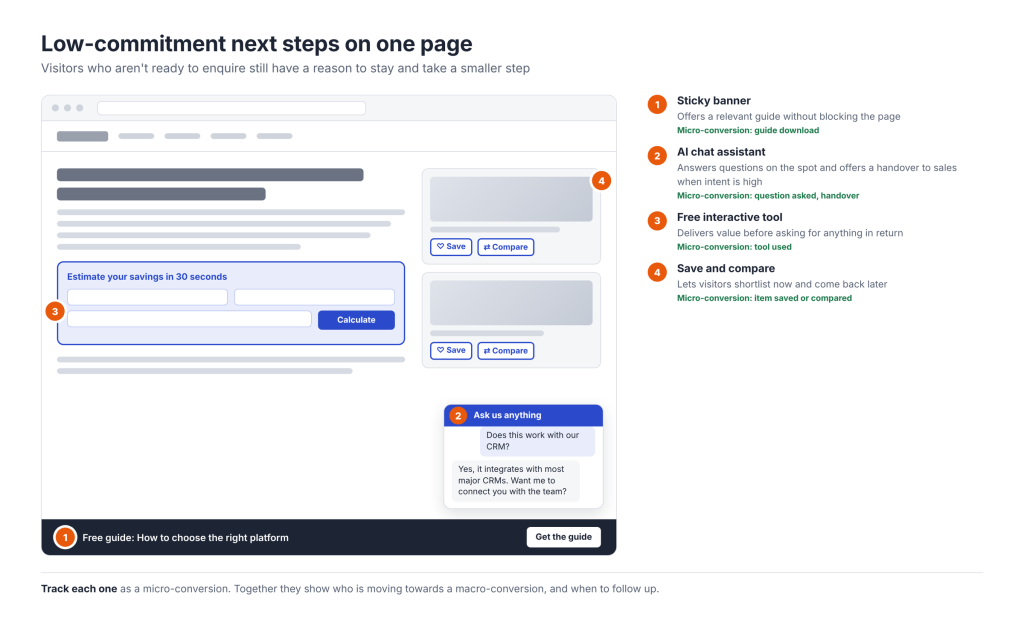
Each of these keeps the conversation going with visitors who are not yet ready for a macro-conversion, and gives you an early signal of their intent.
Match each page to the visitor’s intent
Matching the conversion to the visitor also means making sure the page itself reflects what they are looking for.
A user searching for “how to choose an enterprise CRM” has a different intent from someone searching for “enterprise CRM pricing”. Treating both visitors the same can create unnecessary friction. For instance, directing the informational searcher to an article rather than a sales form ensures the experience aligns with where they are in their decision-making process.
Consider three questions when evaluating a page:
- Is it relevant? Does the page address the user’s immediate need or question?
- Is the next step clear? Does the user clearly understand what they should do next and what they will receive in return?
- Does the action match their intent? Is the call-to-action (CTA) or offer appropriate for their stage in the journey?
For example, an in-depth article about industry challenges could naturally lead to a benchmark report, related case study, or consultation. Sending readers directly to a generic sales form may create a larger commitment than they are ready to make.
CRO therefore starts before the CTA. The entire journey should feel like a logical progression from the user’s initial intent to the desired action.
2. Turn Content Into a Conversion Path
Organic search and content marketing can bring highly relevant visitors to your website, but getting someone to read an article is not necessarily the end goal.
Content hubs and blog articles can also serve as entry points into the wider customer journey.
To make content more conversion-focused:
Add contextual CTAs
Place relevant CTAs within the content where they naturally support the topic being discussed.
For example, an article about SEO measurement could link to a related SEO audit, downloadable framework, or consultation.
Connect informational and commercial content
Create clear pathways between:
Blog → Guide → Case Study → Service Page → Enquiry
The exact journey will vary by business, but the principle is the same: help users move naturally from learning to evaluating to taking action.
Improve content discovery
For large content libraries, consider:
- Topic filters
- Industry filters
- Content-type filters
- Search functionality
- Related content
- Recommended resources
This reduces the likelihood of users reaching the end of a piece of content without an obvious next step.
Good information architecture is therefore part of CRO. If users cannot find relevant information, even strong content and CTAs may go unused.
3. Reduce Friction Across the User Journey
Conversion optimisation is not simply about adding more opportunities to convert. Often, the biggest opportunity is removing the things that make conversion difficult.
Friction can come from many sources:
- Complicated navigation
- Unclear messaging
- Long or confusing forms
- Unexpected steps
- Poor mobile experiences
- Slow-loading pages or distracting interfaces
- Unclear pricing or requirements
- Weak error messaging
- Too many competing CTAs
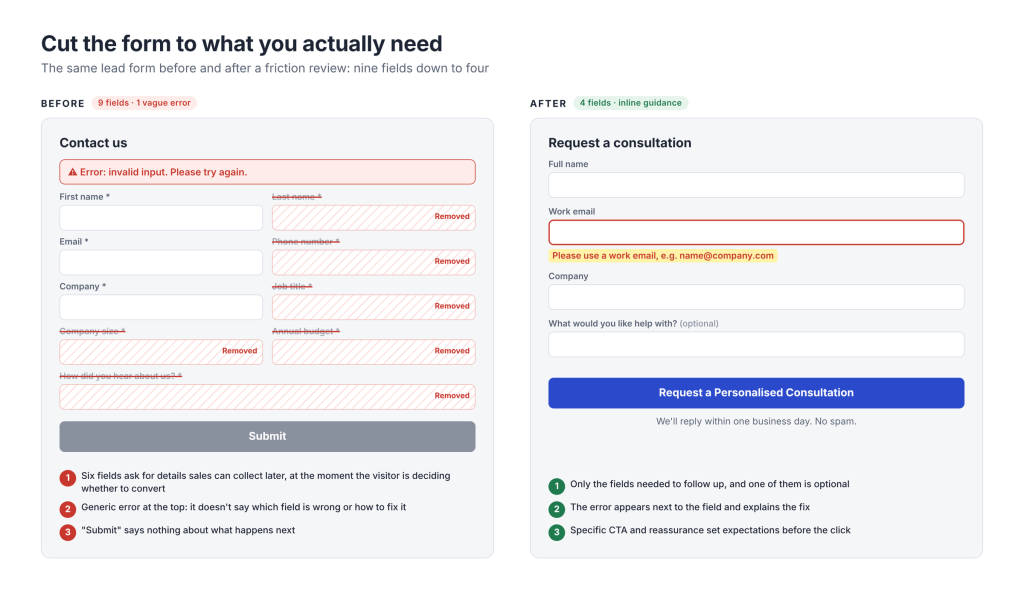
For example, a form asking for unnecessary information creates additional effort at precisely the moment when the user is considering whether to convert. Usability testing highlights form length, field clarity and error recovery as recurring areas of friction.
Across Asia-Pacific: Payment preferences vary widely across Southeast Asia. According to Worldpay’s Global Payments Report 2026, cash on delivery still accounted for 23% of ecommerce value in the Philippines in 2025, while bank transfers led in Thailand at 44%. A checkout that only accepts cards adds friction at the final step in markets like these.
Look beyond individual elements and assess the complete conversion journey:
Can the user understand what is being offered, find the information they need, take the next step, and complete the action without unnecessary effort?
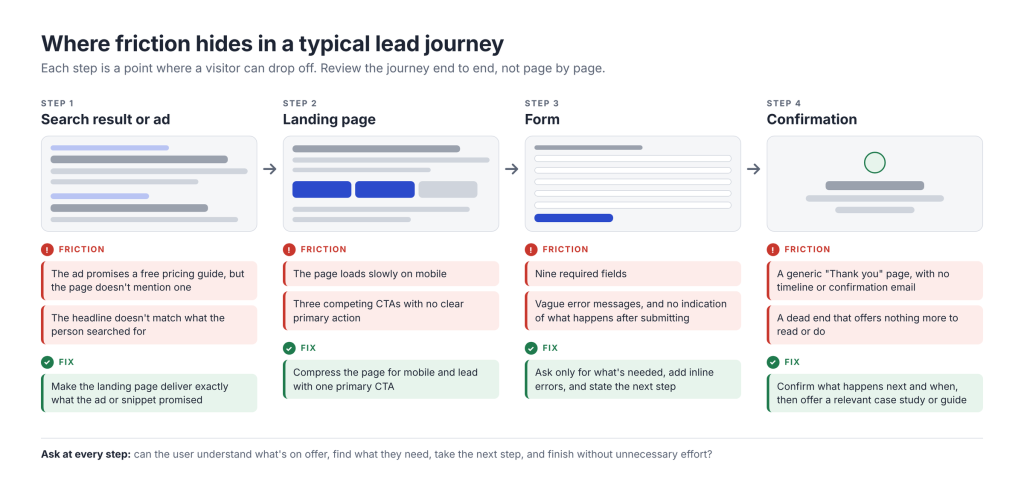
If the answer is no, reducing that friction may be a stronger CRO opportunity than simply redesigning a button.
4. Build Trust Throughout the Journey, Starting Before the Click
Usability is only one part of the equation. Users also need enough confidence to act.
Before asking users to provide personal information, make sure the page answers the questions that may prevent them from converting.
AI IN ACTION
With AI Overviews cutting clicks to the top-ranking page by 58% (Ahrefs, 2026), every visitor who does reach your website matters more than ever.
At The Egg, we pair AI search visibility with evidence-led CRO across APAC markets, ensuring the traffic you earn turns into enquiries and sales.
Depending on the business, this could include:
- What exactly will I receive?
- How much does it cost?
- What happens after I submit this form?
- How will my information be used?
- Is this suitable for my needs?
- Can I trust this company?
- What evidence supports its claims?
Trust signals can include customer testimonials, case studies, reviews, certifications, client logos, guarantees, transparent pricing and clear explanations of what happens next.
Across Asia-Pacific: Which trust signals matter varies by market. Our Japan B2B guide notes that success stories play a key role in how Japanese buyers evaluate a supplier, so a dedicated case study page can do much of the trust-building there.
The appropriate trust signals will vary by industry and conversion type. A B2B consultation page, for example, may need substantially more evidence and reassurance than a newsletter signup.
The principle is simple: reduce uncertainty at the point where users are being asked to commit.
Trust starts before the visit
In AI search, buyers often meet your brand first inside a generated answer that draws on reviews, comparison articles, forum discussions and media coverage. By the time they reach your website, they already have an impression of you, and they are looking for confirmation.
Your website should reinforce that impression with consistent claims, pricing and product details, and with proof such as case studies, certifications and client logos that are easy to find. If your brand faces negative reviews, a past service issue or low awareness in a new market, expect visitors to arrive more sceptical. Pages that address common concerns directly, through FAQs, transparent policies and recent customer evidence, give them a reason to stay rather than a reason to leave.
In other words, trust is built across the whole journey, alongside the micro-conversions in Principle 1, not only at the form.
5. Make CTAs Clear, Relevant and Action-Oriented
CTAs should feel like the natural next step and not an interruption.
Effective CTAs typically communicate three things:
- What will happen?
Users should understand where the action will take them. - What will they get?
The value of taking action should be clear. - Why is this the right next step?
The CTA should be relevant to the content and context around it.
For example, replace vague labels such as:
- “Download” → Download the Free Benchmark Report
- “Submit” → Request a Personalised Consultation
- “Register” → Secure Your Spot at the Webinar
However, CTA copy is only one part of the equation. Consider the CTA placement, hierarchy and surrounding context as well.
Primary CTAs should be visually prominent without competing with every other element on the page. On longer pages, consider using a sticky CTA or repeating the CTA at logical points where users have gained enough information to take action.
Most importantly, make sure the destination matches the promise of the CTA. When users click a generic CTA expecting one experience but are instead immediately presented with an unexpected information request, users tend to abandon the process.
Across Asia-Pacific: In a CSA Research survey of 8,709 consumers in 29 countries, including China, Indonesia and Japan, 76% preferred to buy products with information in their own language, and 40% said they would never buy from websites in other languages. In multilingual markets such as Hong Kong, Singapore and Malaysia, make sure the CTA, landing page and form match the language of the ad or search that brought the visitor in.
6. Adapt the Experience to Each Market
A page that converts well in one market might not necessarily convert in another. Search behaviour, device habits, design conventions, contact preferences and expectations of trust all vary across Asia-Pacific.
Take China and Singapore. In Singapore, Google accounted for 92% of search engine use in September 2026, according to StatCounter. In mainland China, global brands reach buyers through local search engines such as Baidu, Bing China and 360 Search, as well as platforms such as WeChat. Our guide for SaaS and AI tool brands in China recommends phone-number sign-up and WeChat-native onboarding rather than a translated, email-based funnel. Some Western tools also behave differently there: Google reCAPTCHA does not work reliably in China, which can stop forms from submitting.
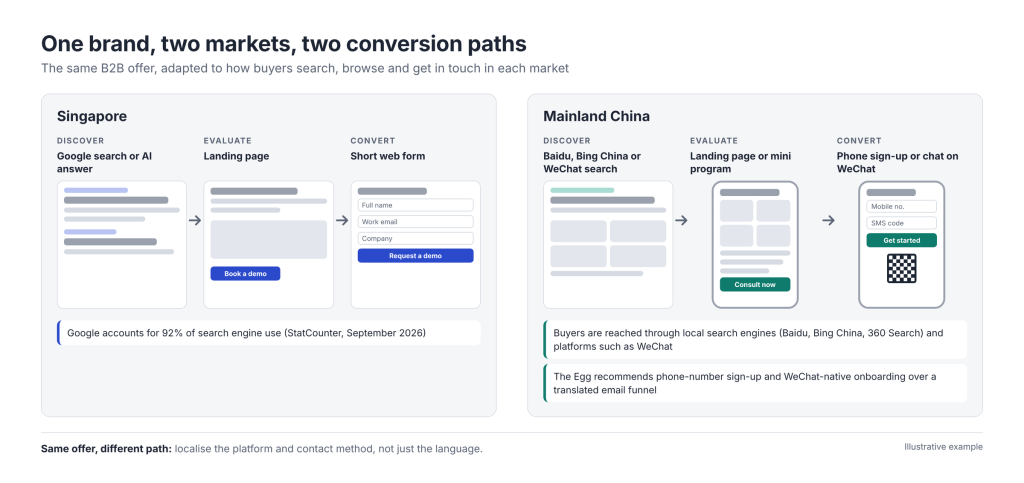
Before rolling out a page across markets, check:
- Which search engines, platforms and devices drive traffic in each market
- Whether form fields, contact methods and payment options match local habits
- Whether page speed and third-party scripts hold up on local networks
- Whether trust signals, such as local client logos, certifications and reviews on local platforms, are relevant to that audience
For more on search in China, see our articles on 5 SEO ranking factors for global brands in China and why Bing in China isn’t global Bing.
Want to convert more of your website traffic?
Speak to The Egg about building an evidence-led CRO roadmap.
We can help identify where users are dropping off, prioritise the biggest opportunities and define a practical testing plan.
7. Use Data to Diagnose Problems and Test the Solution
CRO decisions should be grounded in evidence rather than assumptions about what users “should” do.
Different tools answer different questions:
| Tool | What it can help you understand |
| Analytics (e.g. GA4, Adobe Analytics; Baidu Tongji in China) | Where users enter, exit and drop off |
| Click maps and heatmaps (e.g. Hotjar, Microsoft Clarity, Contentsquare) | Where users interact or appear to focus their attention |
| Scroll-depth tracking (e.g. GA4, Hotjar) | How far users scroll through content |
| Session recordings (e.g. Microsoft Clarity, Hotjar) | How users navigate and interact |
| User research (e.g. interviews, Maze, UserTesting) | Why users behave in certain ways |
| Surveys/feedback (e.g. Hotjar Surveys, Qualtrics) | What users say they need or find difficult |
| A/B testing (e.g. Optimizely, VWO, AB Tasty) | Whether a proposed change produces a measurable improvement in a defined outcome |
Visual tools, including predictive or AI-powered heatmaps, can also help identify potential attention or usability issues before a page goes live. For example, they may indicate whether important content or CTAs are likely to receive sufficient visual attention.
But these tools should be treated as diagnostic inputs, not definitive answers.
A predictive heatmap can suggest that an important CTA may be overlooked. It cannot tell you whether changing its position will increase conversions.
That is where experimentation comes in.
A strong CRO process looks something like:
Observe → Identify → Hypothesise → Prioritise → Test → Measure → Learn → Iterate
The goal is not to prove that a particular design is “better”. It is to understand which changes create measurable improvements for your users and business.
The CRO Mindset: Continuous Improvement, Not a One-Off Redesign
Conversion rate optimisation is not a website redesign project with a defined end date.
User behaviour changes. Customer expectations evolve. New traffic sources bring different audiences. Business priorities shift. What works for one audience or page may not work for another.
The most effective CRO programmes therefore treat optimisation as an ongoing cycle of research, experimentation, and learning.
Start by defining what conversion means for your business. Understand what users are trying to accomplish. Remove unnecessary friction. Make the next step clear. Build trust. Then use data and experimentation to determine which changes improve performance.
Conversion is not the finish line either. A customer who converts once is not the same as one who returns, recommends you, or asks an AI assistant for your brand by name. Onboarding, account areas, post-purchase content and service experiences all shape whether a first conversion turns into loyalty, so relevance, low friction and trust matter just as much after the conversion as before it.
Ultimately, CRO is not about getting users to click more buttons.
It is about creating a digital experience that makes the right action easier for the right user at the right time.
For businesses investing heavily in SEO, paid media, and content, this distinction matters more than ever as AI search reduces the number of people who click through. More traffic creates more opportunity, but improving the experience after users arrive can help businesses generate greater value from the traffic they already have.