

Bing in China Isn’t Global Bing: What You Need to Know Before Entering the Market
Key Takeaways
- Bing CN users are highly concentrated in top-tier cities and are 45% more likely to be high-income earners than the national average.
- Rational, quality-focused buyers dominate; product quality and efficacy drive decisions, while promotions and discounts matter least.
- Global campaigns face barriers with China’s unique requirements for account setup, compliance, and cross-border tracking.
- Partnering with a local China expert streamlines launch, improves approval rates, and ensures campaign visibility and performance.
Bing In China Isn't Global Bing
Bing in China Isn't Global Bing
The Familiar Logo, the Unfamiliar Reality
If you are a marketing leader or growth manager launching a brand in China, you have probably heard your global team say “We’re already running Microsoft Advertising globally — let’s just extend the campaigns into China.”
It sounds reasonable. Same platform. Same interface. Same logo in the corner of the screen. What could be different?
Quite a lot, as it turns out.
Bing in China operates inside a fundamentally different digital ecosystem from the one global search teams are used to. The audience is not representative of the broader Chinese internet population. The platform behaves differently from what international Microsoft Advertising dashboards suggest. And operational realities like account setup, content approval, landing-page hosting, tracking, and cross-border reporting introduce friction that catches even experienced paid search teams off guard.
This article breaks down the differences between Bing China and global Bing, who the audience actually is (backed by verified research), where global search strategies typically break down, and why having an on-the-ground China partner changes the speed, safety, and performance of market entry.
Who Actually Uses Bing in China?
A High-Value Filter, Not a Mass-Market Channel
To understand Bing’s China audience, you have to look past the mass market. It isn’t a representative slice of the 1.1-billion-strong Chinese internet user base. It is a highly specific, self-selected premium segment.
Bing CN users diverge from national averages on every measurable demographic dimension [1]
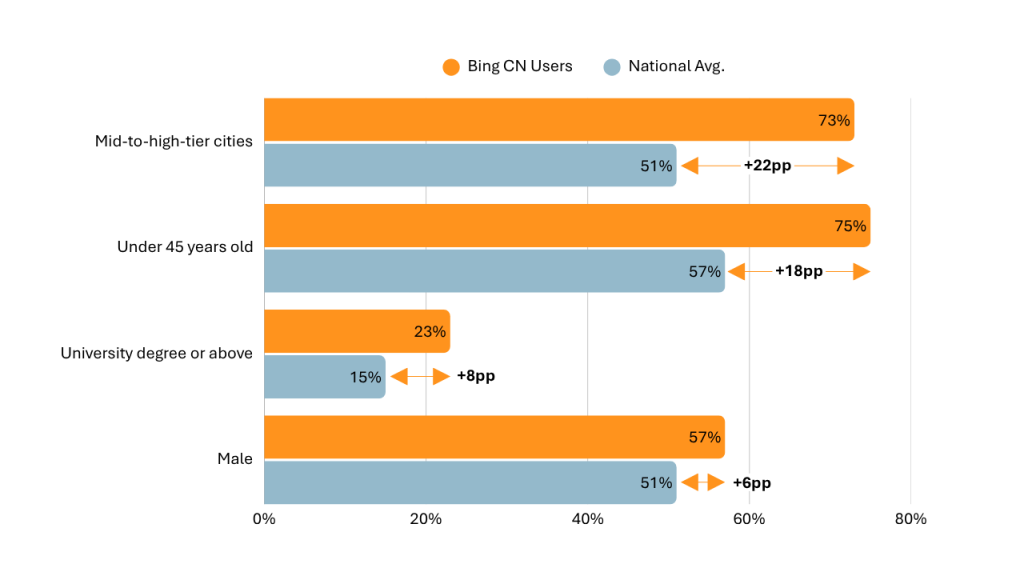
Differences between Bing China audience and national averages
These are not marginal differences. A 22-percentage-point gap on city tier alone means Bing is effectively filtering out low-tier-city traffic. If your brand’s target customer is concentrated in Beijing, Shanghai, Shenzhen, Guangzhou, and other Tier 1-3 cities, Bing is one of the most efficient ways to reach them without paying for audiences you do not need.
The Rational Buyer Profile
Beyond demographics, Bing CN users display distinct buying habits, a clear picture of a rational, independent and deliberative consumer. [2]
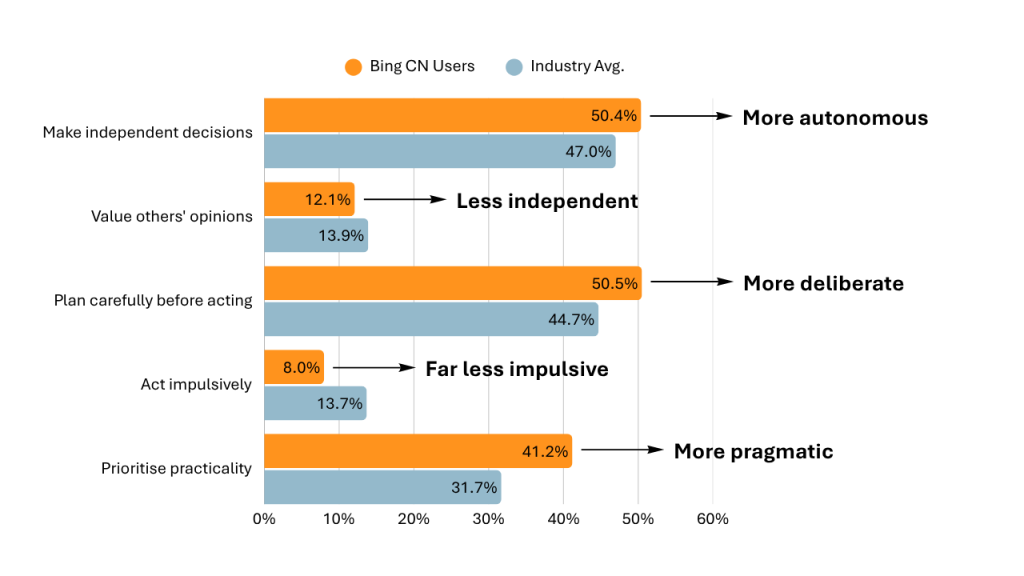
The Rational Buyer Profile
For your brand, this has direct creative implications. Bing CN users are not moved by scarcity tactics (“limited time only”) or social proof (“everyone is buying this”). They respond to data, evidence, comparisons, and authoritative product information. On Bing, a well-structured comparison table outperforms an influencer endorsement. A third-party certification outperforms a countdown timer.
What They Actually Buy — and Why Discounts Don’t Work
When asked to rank purchase decision factors, the results for Bing CN users are striking [2]:
| Rank | Factor | Weight |
| 1 | Product quality | 45.5% |
| 2 | Product efficacy | 41.1% |
| 3 | Product reputation | 40.2% |
| 4 | After-sales service | 39.7% |
| 5 | Brand | 37.3% |
| 6 | Value for money | 36.9% |
| 7 | Price | 35.7% |
| 8 | Discounts / promotions | 29.9% |
Quality leads price by nearly 10 percentage points. Discounts rank last. For teams accustomed to building campaigns around seasonal promotions and price-driven creative, this represents a major strategy shift. On Bing CN, leading with ‘30% off’ isn’t a hook; it’s a signal that the brand lacks a substantive value proposition.
The audience shows strong commercial intent. Average planned annual online spend is 8,241 RMB. Only 1.5% of users plan to spend under 1,000 RMB. Bing CN users are 45% more likely to have a household monthly income of 20K+ RMB compared to the average Chinese internet user (TGI 145). These are high-budget buyers, not bargain hunters.
Why Do Global Search Strategies Fail in China?
The user data tells us who the audience is. The operational reality tells us why serving them well requires more than a translated global campaign.
Account Setup and Platform Access
While Microsoft Advertising provides a globally unified interface, the path to a fully functional Bing CN account often involves steps invisible from overseas. Local entity registration, ICP filing for landing pages hosted inside China, and the payment methods accepted by the platform can all introduce delays if not planned for in advance. Teams who assume they can spin up a China campaign the same way they launch a UK or US campaign frequently encounter multi-week delays that disrupt launch timelines.
Content, Compliance, and the Localisation Gap
Translating ad copy is not the same as localising it for Bing’s China audience. The data makes this clear: Bing CN users prioritise quality signals, efficacy claims, and substantive product information. An ad that reads well in English but feels generic or emotionally manipulative in Chinese will underperform — not because of language, but because of the audience’s psychological profile.
There is also China’s advertising compliance environment. Certain product claims, comparative language, and superlative terms face stricter scrutiny. Creative that sails through approval in London or Singapore may need significant revision to clear in China. Without local review, this becomes a recurring bottleneck.
Tracking, Attribution, and Reporting Friction
UET (Universal Event Tracking) operates in China, but cross-border data flows, local analytics integration, and standard dashboards used for global reporting may not ‘just work’ when the conversion path runs through Chinese-hosted landing pages and local CRM systems. This can lead to attribution gaps that make Bing CN performance look worse than it actually is — or hide optimisation opportunities entirely.
Microsoft Clarity is a genuinely underutilized asset that can help close some visibility gaps — but only if someone on the ground knows how to configure it against a China-specific user journey.
Do I Need a Local Partner to Run Bing Campaigns in China?
When viewed as a whole, these are not exotic problems—they are operational friction that slows down market entry, burns budget during the learning phase, and erodes internal confidence. The common thread is that none of them are visible from the global Microsoft Advertising dashboard. They only surface when someone is working inside the China digital ecosystem day to day.
The Egg operates at the intersection of your brand’s strategic planning and China media execution. We work with in-house marketing teams and international brands to give them the local edge.
Our role: We bridge the gap between your global strategy and local delivery. That means handling account readiness and setup, localising creative against the Bing CN audience profile (not just translating it), navigating the compliance landscape, configuring tracking so performance is visible to your headquarters, and providing operational reporting that your team and global leadership can use without interpretation overhead.
We work as your dedicated local execution layer with our local knowledge, our platform fluency and our on-the-ground presence.
The Bottom Line
Bing is a powerful channel for reaching premium Chinese consumers, the data is clear. But treating Bing China as a simple extension of global Microsoft Advertising is one of the most common and costly assumptions in cross-border search marketing. The audience is different. The creative playbook is different. The operational path from campaign planning to live delivery is different.
The brands that succeed in China on Bing are not the ones that spend the most. They are the ones that recognise the differences early. If you are planning or running China search campaigns, we would welcome a conversation. No pitch. Just an honest look at where your China search setup stands today, and where a local partner might help it run better.
Frequently Asked Questions About Bing China Market Entry
Q1: Is Microsoft Advertising in China the same as global Bing Ads?
No. While Microsoft Advertising provides a globally unified interface, Bing’s China operation runs inside a fundamentally different ecosystem. The user base is a highly filtered premium audience, the creative playbook differs (quality-led, not price-led), and operational factors create meaningful friction that global dashboards do not surface.
Q2: Who uses Bing in China?
Bing CN users are disproportionately educated, urban, high-income, and under 45. They are rational, independent decision-makers prioritising product quality and efficacy over price.
Q3: Why do global Bing campaigns fail in China?
Three main reasons: creative strategy designed for emotionally-driven consumers doesn’t resonate with Bing CN’s rational users; ad copy translated but not localised against China’s compliance environment faces approval delays; tracking setups that work globally produce attribution gaps through Chinese-hosted infrastructure.
Q4: Do I need a China-based partner to run Bing search ads?
It is technically possible from overseas, but in-house marketing teams consistently encounter longer launch timelines, higher creative-rejection rates, attribution blind spots, and steeper learning curves.
Q5: What industries perform best on Bing China?
Technology/AI, B2B and SaaS, higher education, financial services, luxury, premium automotive — any category where purchase decisions are research-intensive and quality-driven. The controlled ad environment also suits brands with high brand-safety requirements.
[1] GWI data, Q2 2024 to Q1 2025. Comparison of Bing CN users against national Chinese internet user averages across city tier, age, education, and gender.
[2] iResearch data, December 2024 (N=1,000). Analysis of consumer traits, buying habits, and purchase decision factors. Includes TGI (Target Group Index) data on household income and commercial intent.
Ready to bridge the gap between your global search strategy and local execution in China?
Let’s take an honest look at your account together – book a time with our team to get your no-obligation China search consultation.
Want to learn more? Get insights about China’s digital market here.


How Can We Help?
HOW CAN WE HELP?

