

5 SEO Ranking Factors for Global Brands in China
According to CNNIC’s 57th Statistical Report on Internet Development in China (February 2026), there are 1.125 billion internet users in China as of December 2025. This represents a net increase of 136 million users in the last 5 years — roughly equivalent to the entire population of Mexico — underscoring that China’s digital goldmine has only grown richer.
As we know, Baidu is the #1 search engine in China. It’s essentially the Google of China. In 2025, Baidu underwent its “biggest overhaul in a decade” (announced July 2, 2025 at Baidu AI Day), transforming from a traditional search engine into an AI-native ecosystem platform. Its search box now supports multimodal inputs (text, voice, images), and AI-generated answers have replaced traditional ’10 blue links’ for many query types. This step has won back quite a few lapsed users. Keep in mind, though, that optimizing for Baidu isn’t the same as optimizing for Google.
Baidu SEO has its own complex set of challenges informed by Chinese regulations, compliance issues, censorship, technical considerations, and other China-specific requirements.
Today, let’s talk about critical SEO ranking factors when preparing your global site for China.
China SEO Ranking Factor #1: Page Load Speed
Your site’s user experience and ease of crawlability are directly linked to your load speed, specifically how fast your site can fully display all the content on its webpages.
However, it is common for international websites that are hosted outside of China to experience slow loading speeds since they must undergo the scrutiny of the Great Firewall, China’s online censorship system that regulates local access to foreign websites.
In addition, Baidu prioritizes page load speed as a ranking factor and emphasizes that webpages should ideally load within 1.5 seconds.
With that said, let’s explore three ways you can improve your page load speed in China.
Obtain an ICP License
Internet content provider (ICP) licenses are issued by the Chinese Ministry of Industry and Information Technology (MIIT). ICP licenses authorize you to host your website in China. Without one, you cannot host your site on Chinese servers, which severely lags your load speed.
Whether an ICP filing is required depends entirely on your server’s physical location. Under MIIT regulations, an ICP filing is a mandatory legal requirement for any website hosted on servers physically located within mainland China. Conversely, if your site is hosted offshore (such as in Hong Kong or the U.S.), an ICP is technically not required. However, for brands committed to the China market, we strongly recommend mainland hosting to ensure optimal performance, faster loading speeds, and better visibility on local search engines like Baidu. Consequently, obtaining an ICP filing should be treated as a vital prerequisite for any professional and compliant digital presence in the region.
Create a CDN For Your Website
To avoid page loading issues in China, we also recommend leveraging a content delivery network (CDN) on your website.
A CDN is a geographically distributed network of proxy servers that speeds up the delivery of web content by bringing it physically closer to end users.
CDNs have the following advantages:
- CDNs enhance user experience with faster page loading times.
- CDNs improve your site’s crawlability due to faster load times for content on your site, as well as image compression.
- CDNs safeguard your site from malicious cyberattacks like distributed denials-of-service (DDoS) by minimizing the risk of traffic spikes at point of origin.
For global brands seeking CDN and hosting solutions in China, the three dominant providers are Alibaba Cloud (阿里云), Tencent Cloud (腾讯云), and Huawei Cloud (华为云). All hold ICP qualifications and offer integrated CDN + hosting packages specifically designed for compliance with Chinese regulations.
Remove Blocked APIs
Your existing global website may have several application programming interfaces (APIs) in place to improve your UX—many of them, however, do not work in China.
All Google-related services, for instance, are blocked in China, so your China SEO strategy must involve an analysis of which APIs or plugins are blocked and substitute them with ones that work in China. Failing to do so may hinder your site load speed and negatively impact your user experience.
Beyond Google services, global brands should also check: Facebook Pixel, Twitter/X embeds, YouTube videos, Vimeo, Typekit/Adobe Fonts, Stripe, and PayPal (use WeChat Pay / Alipay instead).
When it comes to analytics, Google Analytics is still the go-to tool, though users should be aware of occasional tracking gaps. Baidu Tongji is available for basic metrics—such as traffic sources and Baidu-specific keywords—but it is quite simplistic and falls short when it comes to complex, cross-dimensional data correlation.
China SEO Ranking Factor #2: Content Localization
In recent years, Baidu has increasingly prioritized content quality as a ranking factor. For global brands, the starting point is localizing content for Chinese users—and knowing and actioning upon how and why they search—to get found.
As more international companies look to expand their digital presence in China, they will have to do more than simply translate a mini-site to serve Chinese audiences.
With seven main dialects, the Chinese language is complex and carries subtle but critical nuances that make direct translations (i.e., word-for-word) from another language insufficient.
Thus, it is imperative that you work with professional translation services or localization specialists (like us!) as relying solely on auto-translate functions may make your content sound awkward and fail to resonate with Chinese audiences.
In addition to tailoring your content to the local language, you should also adapt your content based on not just local currency, time zone, and payment methods but also the culture and lifestyle of Chinese audiences.
China SEO Ranking Factor #3: Site Crawlability
A sitemap is a list of all the URLs on your site and helps search engine crawlers decipher your site structure and index your webpages to serve on their SERPs. Most websites prefer sitemaps in XML format since they contain more information on top of URLs, such as ‘date modified’ and priority level.
Since 2020, Baidu Webmaster Tools no longer supports XML map indices and advises all account administrators to remove previous submissions of XML map documents that contain multiple XML sitemap links. Note that this does not affect XML sitemaps, which can still be indexed by Baidu.
In December 2025, Baidu Search Resource Platform announced the termination of direct XML sitemap submission entirely. Both the standard URL submission tool (普通收录) and the dead-link submission tool (死链提交) no longer accept XML sitemap files. Previously submitted sitemaps will no longer be processed.
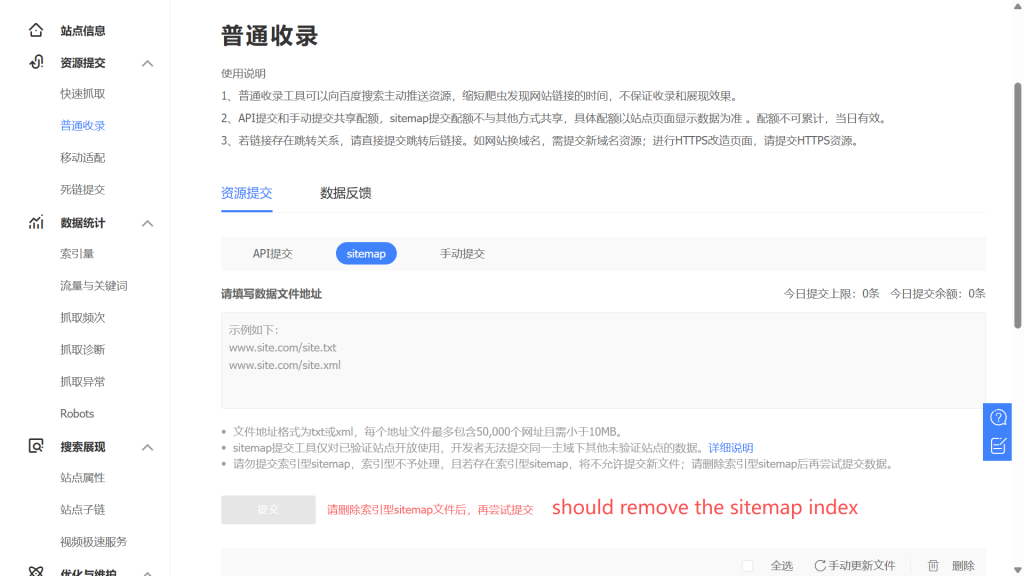
Sitemap Index files are not accepted by Baidu Webmaster Tools.
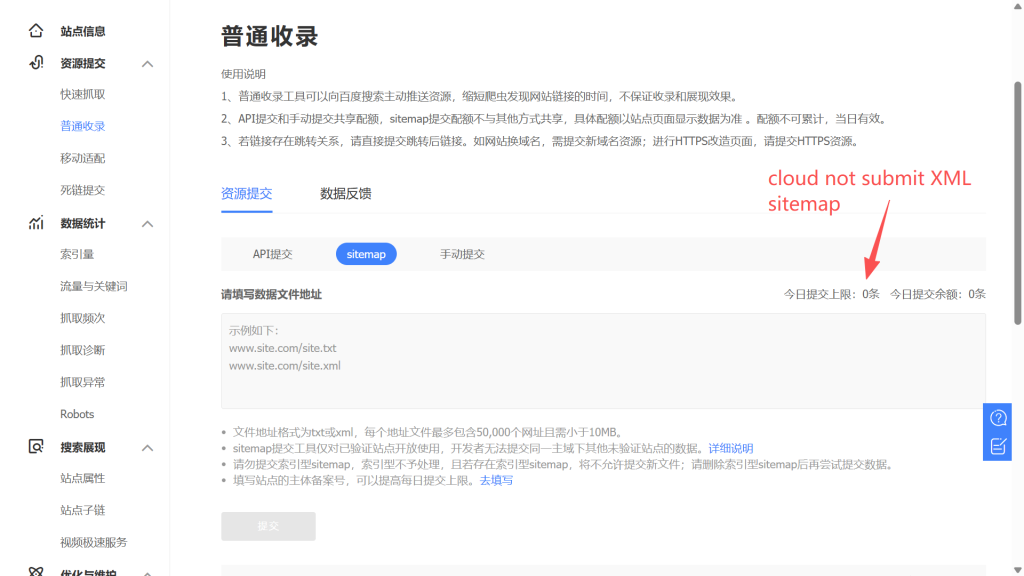
Zero quota available for XML sitemap submissions.
This is a major policy shift — Baidu is moving away from sitemap-based discovery in favour of its own intelligent crawling algorithms. For site owners, this means:
- Relying on Baidu’s automatic spider crawl as the primary indexing mechanism
- Ensuring clean internal linking structures so Baidu Spider can discover all important pages organically
- Using the API-based submission tools (API推送) in Baidu Search Resource Platform for time-sensitive content
Pro tip: Whether submitting via API or relying on organic crawl, ensure your site only exposes live, indexable URLs to Baidu.
China SEO Ranking Factor #4: Mobile-friendliness
Ensuring that your website is mobile-friendly is crucial for succeeding in China’s online marketplace, where over 95% of its total netizen population are mobile users.
The latest data paints an even more striking picture: according to CNNIC’s 57th Statistical Report (January 2025), 99.6% of Chinese internet users access the internet via mobile phones as of December 2025. China is not just mobile-first — it is now near-100% mobile.
Hence, if you do not optimize your site for mobile, you run the risk of driving potential customers to your competitors’ sites.
China SEO Ranking Factor #5: Dedicated Hosting
Avoid shared hosting at all costs. Shared hosting refers to the sharing of a single server (including CPU, disk space, memory space, etc.) between your site and thousands of other websites. As such, shared hosting is highly prone to slower load times and security risks for your site.
Dedicated hosting services, by contrast, do not require you to share any of these resources with other domains.
For brands targeting the China market, the optimal hosting architecture in 2026 is: Mainland China server (with ICP license) + Chinese CDN (Alibaba Cloud / Tencent Cloud / Huawei Cloud) + optional Hong Kong/Macau mirror for failover. This configuration provides both compliance and performance. Avoid hosting in neighboring Asian countries (Japan, Singapore) as a ‘compromise’ — cross-border latency still triggers Baidu’s speed penalties.
***
With online competition soaring in China, ensure that you stay on top of Baidu’s key SEO ranking factors and make the necessary technical implementations before launching your site in China.