
Naver AI Content Guidelines (2026): How to Create Content That Gets Cited in AI Briefing
Why Naver’s AI Shift Changes the Rules for Korean Search
In 2026, Naver’s AI Briefing is now applied to 20% of all Naver search queries before users ever click through to a website. For global brands investing in Korean content, this shift introduces a critical new gatekeeper: Naver’s AI decides which sources get cited, summarized, and surfaced—often replacing the need to visit your site at all.
The risk? Even top-ranking content can become invisible if AI systems don’t trust it enough to reference. Traditional SEO metrics—rankings, clicks, impressions—no longer tell the full story of your Korean search performance. We’re seeing well-optimized brand content rank in positions 1-3 yet receive zero AI citations, while lesser-known sources with stronger expertise signals dominate the AI Briefing summaries.
The opportunity? Naver just published detailed AI content guidelines, including real examples of what gets cited (and what doesn’t). Brands that adapt now can establish AI authority before competitors understand the rules have changed.
This article decodes Naver’s official guidance and shows how to restructure content for AI citation
Naver AI Content Guidelines
Bing in China Isn't Global Bing
Rise of AI-powered search experience on Naver
Over the past year, Naver has accelerated its transformation from a traditional search engine into an AI-powered discovery platform.
In this sense, Naver appears to be following a similar AI search trajectory to Google, moving from AI-generated summaries in search results toward more conversational, multi-turn search experiences. Just as Google AI Overviews provide AI-generated snapshots within search results and Google AI Mode enables deeper conversational exploration, Naver’s AI Briefing introduces summarized answers directly into search results and automatically surfaces related questions.
Building on this, the recent beta release of AI Tab expands the experience into conversational search, allowing users to ask complex questions and refine their searches through follow-up interactions based on context and preferences.
Rather than simply displaying a list of websites, Naver is increasingly helping users find answers within its own ecosystem. In other words, a single search is increasingly becoming the starting point of an extended discovery journey rather than a simple keyword lookup.
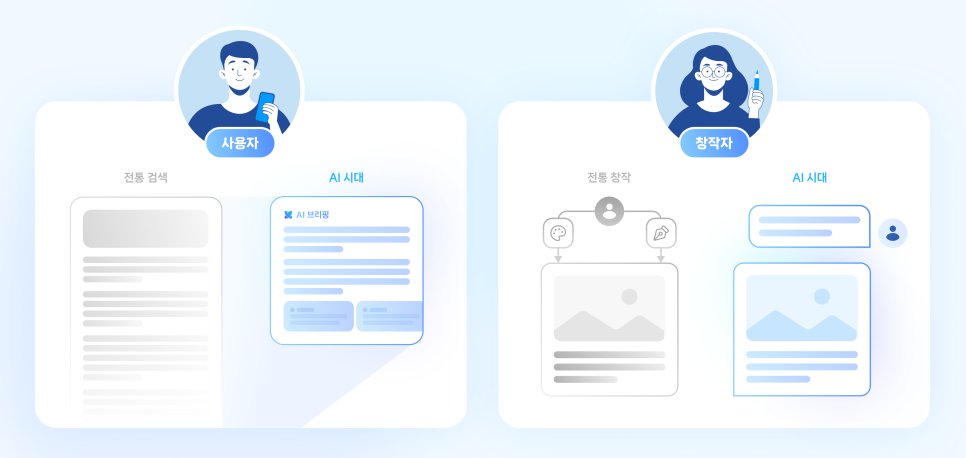
Naver’s AI-powered search shift changes the experience for both users and creators: users receive summarized AI Briefing answers directly in search results, while creators must focus on producing trustworthy, AI-readable content that can be cited and surfaced in the AI era. On the left, the “user” side compares conventional search, where users browse a list of results, with the AI era, where Naver’s AI Briefing summarizes answers directly in the search experience. On the right, the “creator” side shows how content creation is also changing: instead of simply publishing content for standard search visibility, creators now need to produce content that can be understood, trusted, and surfaced by AI systems.
Why Traditional SEO alone is no longer enough even in Korea
As Naver AI becomes a bigger part of the search experience, creating high-quality content is no longer just about ranking on the first page but becoming a source that AI systems trust enough to cite and reference.
For businesses and marketers, this means success is no longer measured solely by clicks or rankings. Visibility within Naver AI Briefing can become another important touchpoint for brand discovery and authority. If your content is cited by the AI, you’re positioned as the trusted expert before users even consider alternatives.
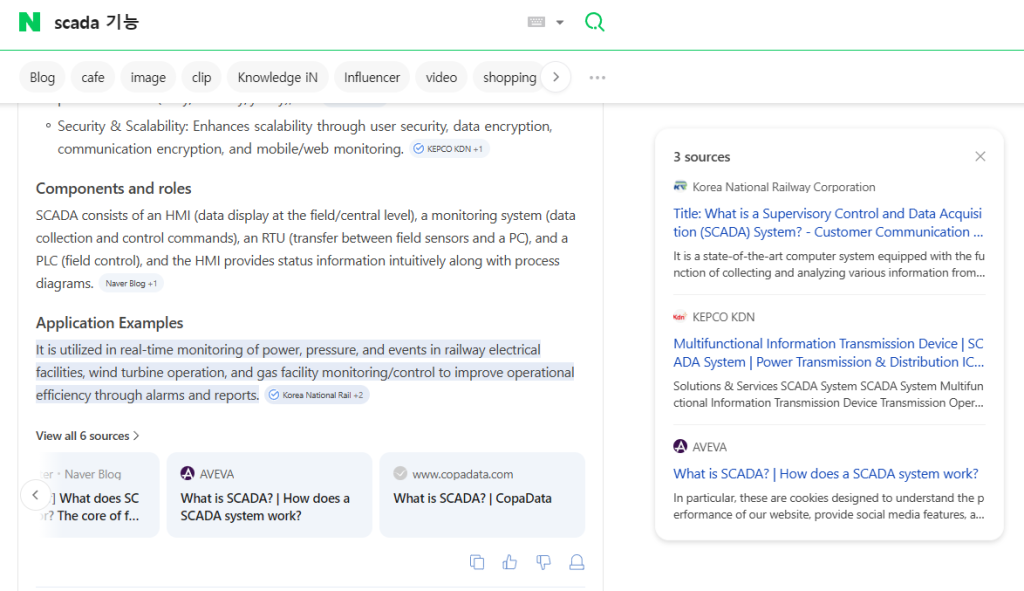
Here’s what that looks like for our client AVEVA:
For the Korean query “SCADA 기능” (“SCADA functions”), AVEVA is cited as one of the sources in Naver’s AI Briefing, appearing alongside the AI-generated summary and source panel. This suggests that AVEVA’s educational content is being recognized by Naver as a relevant reference for users researching related topics. While this citation does not by itself confirm conversion impact, it creates a valuable visibility opportunity by placing AVEVA within the user’s initial research experience, helping support brand awareness and topical authority in Naver’s AI-generated search environment.
To help creators adapt, Naver recently published on 26th May, where they released real examples of content that performs well (and content that doesn’t).
In this article, we’ll break down the key principles behind the official guidelines, analyze what they mean for marketers and explore practical ways to create AI-optimized content that is better positioned for visibility in Naver AI Briefing.
Why Korea Requires Specialized Expertise
Unlike Google, Naver controls 60%+ of Korean search and prioritizes its own ecosystem (Naver Blog, Café, Shopping, Place). AI Briefing deepens this walled garden—success requires understanding Naver’s unique ranking signals, user behavior patterns, and content formats that don’t exist in Western markets.
We consistently see global agencies applying “international SEO best practices” to Korea and underperforming against Korea-native strategies. The platforms are fundamentally different, and winning AI search citation adds another layer of complexity that requires market-specific expertise.
What are the Key Principles of Naver AI Content Guidelines
Naver’s new guidelines confirm what we’ve observed working with clients: AI citation requires a different content DNA than traditional SEO. Here are the core principles that determine whether your content gets referenced or ignored.
Prioritize user value over search optimization
Perhaps the strongest message throughout Naver’s announcement is surprisingly simple: create content for people, not algorithms.
Rather than asking, “Which keywords should I include?”, brands should begin with a different question: “What problem is this content helping users solve?”
Instead of producing a generic article titled “Best Productivity Apps,” for example, a more valuable approach prioritizes audience needs over search optimization by explaining how different productivity tools compare for different audience groups, such as remote teams, freelancers or students.
The difference ultimately lies in whether your content contains contextual information that helps readers make real, informed decisions.
Create content based on first-hand experience and expertise
Human experience, and original content are becoming increasingly important as AI-generated answers make generic information easier to replicate. AI models can summarize existing information remarkably well, but they cannot replace first-hand observations, personal testing, or industry expertise.
For creators, this creates an opportunity rather than a challenge.
Instead of competing with AI on producing generic summaries, creators should focus on publishing content that includes:
- Original research or observation findings
- Real project experiences
- Personal testing results
- Professional insights
- Practical recommendations based on actual implementation
These elements make content significantly more useful while increasing its uniqueness. From an AI perspective, this type of content also provides richer context and more distinctive information to reference.
Deliver complete and trustworthy information
Another recurring theme throughout the official guidelines is completeness.
Many articles answer only the initial question while leaving readers searching for additional information elsewhere. High-quality content, on the other hand, anticipates follow-up questions and provides supporting explanations, examples, and context within the same page.
Example: Basic vs. Complete Product Review
A basic product review might simply state:
“The Samsung Galaxy S26 has a 6.7-inch display and a 5,000mAh battery.”
A comprehensive article that differs from a basic one would predict the follow-up questions users are likely to ask next:
- Who is this phone best suited for?
- How does it compare to the previous generation?
- How long does the battery last in real-world usage?
- What are the biggest pros and cons after hands-on testing?
- Is it worth upgrading at its current price?
The second approach creates a much stronger user experience while naturally improving semantic relevance for AI search systems.

Image: Across the official guidelines, Naver consistently reinforces originality, expertise, and usefulness over keyword-focused optimization. This image shows examples of content topics centered around real user needs, such as “places to visit with children” and “easy sleep routines for children.” The person in the center represents a content creator sharing helpful knowledge, while the surrounding icons suggest different areas of expertise or experience. Overall, the image supports Naver’s guideline that strong AI-search content should be useful, original, and based on real experience rather than written only for keywords.
Develop unique perspective instead of rewriting existing content
Perhaps the biggest takeaway from Naver’s new guidance is that originality matters more than ever.
The internet already contains countless articles that summarize the same information using slightly different wording. Publishing another version of existing content adds little value for readers, or for AI systems deciding which sources deserve attention.
When creating content, ask yourself:
“What perspective or insight can only I (or my brand) provide?”
This could include:
- Analyzing industry trends
- Comparing different strategies
- Documenting real experiments
- Explaining lessons learned from practical experience
What We Can Learn from Naver’s Good and Bad Content Examples
Naver released side-by-side comparisons of content that gets cited versus content that gets ignored. Based on their examples and our own analysis, here’s what separates winners from losers.
Characteristics of high-quality content
High-performing content tends to have a clear purpose and follows a logical structure that guides readers from problem to solution. Rather than overwhelming users with unnecessary information, it focuses on answering questions directly before expanding with supporting details.
Successful articles also demonstrate evidence of human involvement. They include opinions, experiences, observations, screenshots, comparisons, or practical recommendations that add context beyond publicly available information.
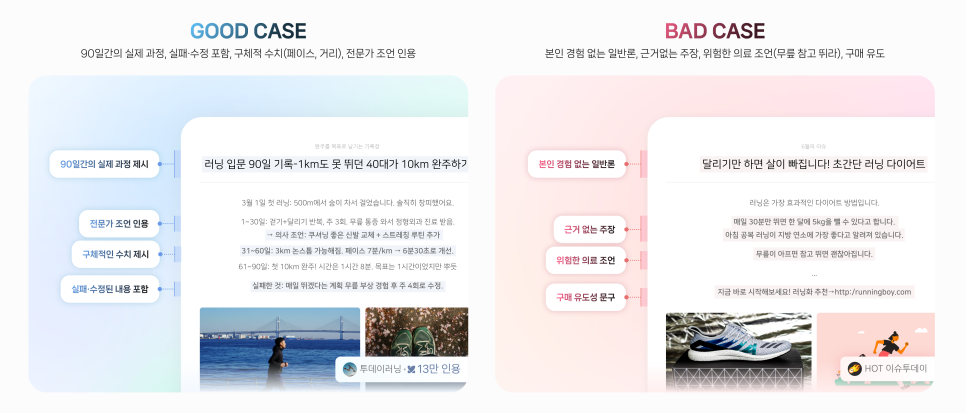
Image: This image compares a “good” content example with a “bad” one. The good case shows content based on real experience, e.g. a 90-day running journey, specific data such as distance, expert advice, and honest updates about the process. The bad case shows generic content with vague personal claims, unsupported statements, exaggerated weight-loss promises, and purchase-focused language. Overall, the image explains that Naver is more likely to value content that is specific, authentic and helpful, while low-quality content that feels generic, promotional or unreliable may be ignored.
This type of content is naturally more engaging because it feels authentic instead of being AI generated.
Why generic content is considered ‘bad’ content
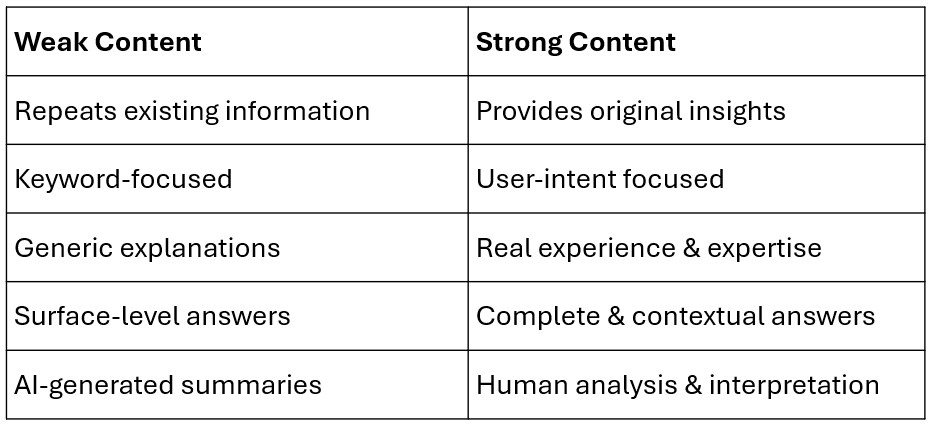
By contrast, weaker examples often share similar characteristics:
- They repeat information that already exists across multiple websites.
- They provide broad explanations without supporting detail.
- They offer little indication that the author has genuine knowledge or experience with the topic.
- The message behind the official examples is clear: quality is measured by usefulness, not by volume.
How to Structure AI-Friendly Content
While there isn’t a single formula for creating AI-friendly content, one common characteristic appears across Naver’s recommendations: high-quality articles answer users’ questions clearly before expanding with context and supporting details.
A simple framework that aligns well with this approach is:
Question → Direct Answer → Supporting Explanation → Real Example → Key Takeaway
This structure improves readability for users while helping AI search systems understand the relationship between questions, answers, supporting context, and practical insights. Rather than encouraging readers to search elsewhere for missing information, it delivers a complete and coherent experience within a single page.
How to Shift from Keyword Optimization to Content Value
Naver’s latest guidelines aren’t introducing entirely new ranking factors, they’re merely reinforcing a long-term shift toward rewarding content that demonstrates expertise, experience, originality, and genuine value.
For marketers and brands, this is ultimately positive news. It means that high-quality unique content built around useful insights is more sustainable than chasing algorithm updates or keyword trends.
As AI search continues to reshape the digital landscape, brands most likely to succeed will be those who focus on
- Answering questions thoughtfully
- Sharing authentic expertise
- Publishing content that deserves to be referenced
Looking to future-proof your content strategy for AI-powered search?
Whether you’re entering the Korean market or refining your existing SEO approach, our Korea-native search specialists can help you develop a tailored AI content strategy built around user intent, topical authority and long-term organic growth.
Why The Egg?
Unlike agencies that apply global SEO templates to Korea, we’ve built our expertise from the ground up within Naver’s ecosystem. Our team:
- Are native specialist team based in Korea with daily immersion in Naver platform updates
- Has achieved measurable AI citation results for clients in competitive categories
- Understands the nuances of Naver Blog, Café, Shopping, Place, and how they feed AI Briefing
Our AI-First Content Services Include:
- AI Readiness Audit: Evaluation of your current content compatibility with Naver AI search
- Korea Content Strategy: User intent research, topic architecture, and AI-optimized content frameworks
- Native Content Creation: Korea-first content built for AI citation, not only translated from global assets
- AI Brand Visibility Tracking: Monitoring AI Briefing visibility and citation share
- Ongoing Optimization: Monthly refinements based on emerging AI citation patterns
Get in touch to explore AI-first content strategies tailored to your business goals!