
China vs. Global Large Language Models (LLMs): Adapting Your Digital Presence for the AI Search Era (GEO) (Part 1 of 3)
This article is Part 1 of a 3-part series and serves as a strategic guide
for global brands entering China’s AI search ecosystem.
Part 2: Key Players, Data Sources, and Trust Signals in
China’s AI Ecosystem
Executive Summary
The transition from SEO to Generative Engine Optimization (GEO) represents one of the most significant shifts in digital marketing. For brands targeting China, this challenge is intensified by a parallel AI search ecosystem that operates on entirely different principles from the West.
Key Takeaways:
- China’s GenAI user base reached 602 million in 2025 (141.7% YoY growth)
- 76% of users rely on AI primarily for Q&A and purchase decisions
- Doubao (72.2%) and DeepSeek (62.0%) are the most widely used AI models in China.
- Chinese LLMs prioritize walled-garden platforms over independent websites
- Success metric shifts from Ranking & Traffic to AI Share of Voice (SOV)
The New Divide in LLMs
In 2026, the global digital landscape has undergone a fundamental shift: the transition from traditional SEO to Generative Engine Optimization (GEO). Presence is no longer just about search engine rankings. Today, success means being the cited source within AI-generated answers.
This evolution, however, has introduced a challenge: the widening divide between Western and Chinese LLMs. For global brands, understanding the scale of China’s AI search ecosystem is now a baseline requirement.
The Scale of the Chinese AI Boom (As of Dec 2025)
Market Adoption: China’s GenAI user base hit 602 million, representing a 141.7% YoY increase (adding 353 million users in just one year). Overall penetration reached 42.8%1.
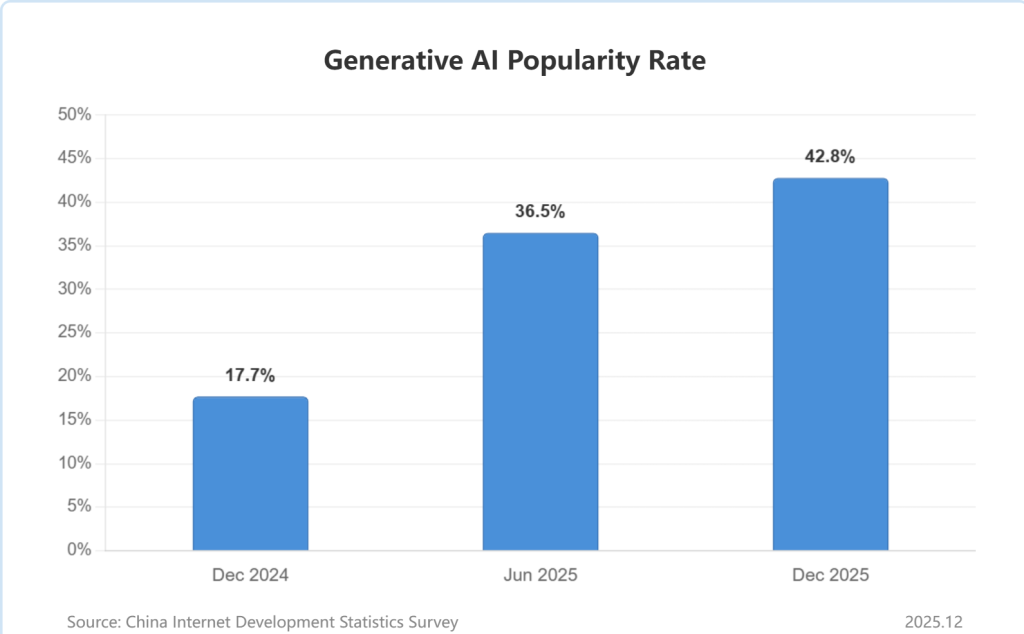
Figure 1: Generative AI Popularity Rate
The GEO Opportunity: 76.0% of users use GenAI primarily for Q&A, making it the dominant use case. (Other applications include image/video generation at 47.8%, text generation at 37.6%, and work summaries/PPTs at 32.5%)1.
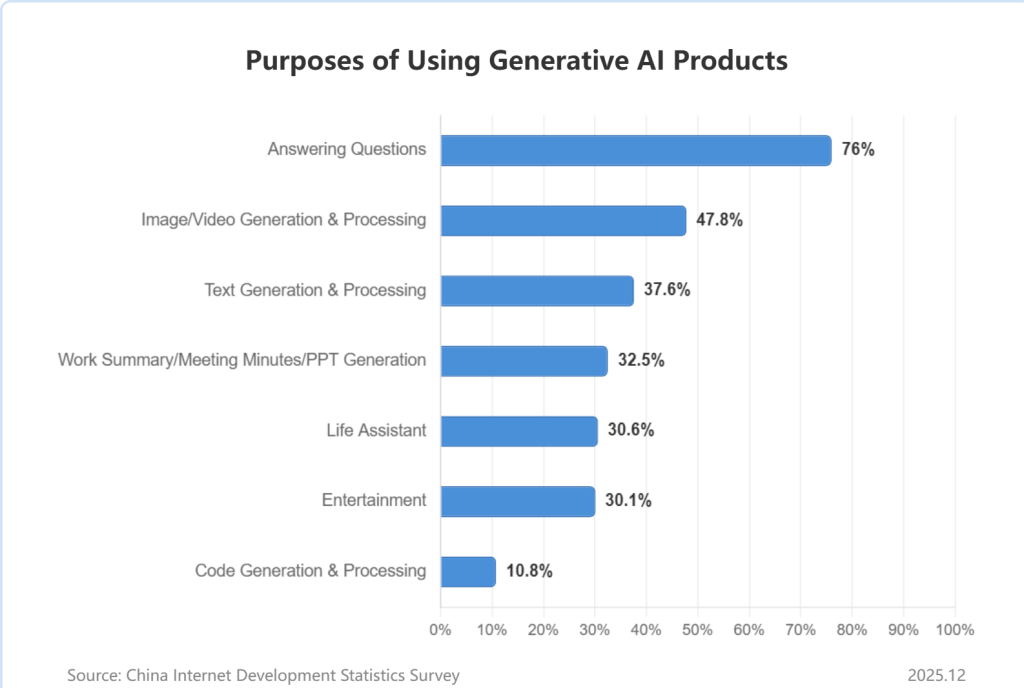
Figure 2: Purposes of Using Generative AI Products
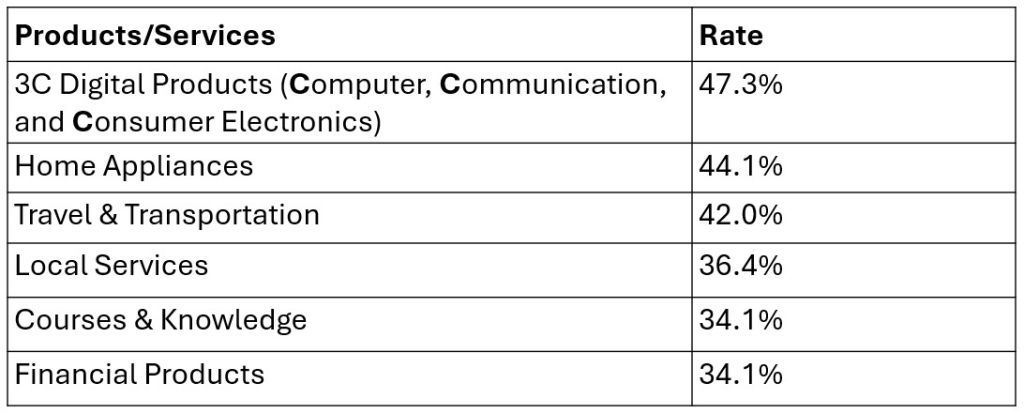
Before purchasing products or services, over 80% of users use AI search to assist their purchase decisions, especially for products with high technical barriers and long decision-making cycles.2
TOP 6 Products/Services Where Users Use AI to Assist Search or Decision-Making2
| Products/Services | Rate |
| 3C Digital Products (Computer, Communication, and Consumer Electronics) | 47.3% |
| Home Appliances | 44.1% |
| Travel & Transportation | 42.0% |
| Local Services | 36.4% |
| Courses & Knowledge | 34.1% |
| Financial Products | 34.1% |
AI Becomes a Middleman Between Enterprises and Buyers
In enterprise business operations, AI has become an absolutely necessary component.
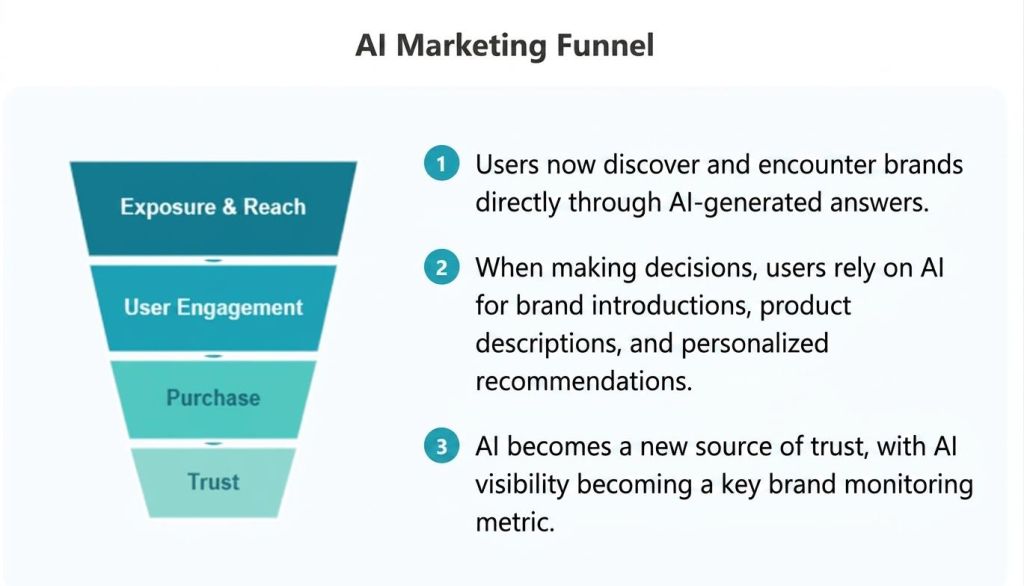
AI Marketing Funnel Diagram
- Exposure & Reach: Users now discover and encounter brands directly through AI-generated answers.
- User Engagement: When making decisions, users rely on AI for brand introductions, product descriptions, and personalized recommendations.
- Purchase and Trust: AI becomes a new source of trust, with AI visibility becoming a key brand monitoring metric.
To succeed in this era, brands need a strategy that works for both traditional and AI search. In this blog, our experts break down the how discovery is changing, how trust is earned and the specific steps needed to bridge the AI divide:
- The Global Ecosystem: ChatGPT, Perplexity, Google AI Overviews, and Claude (trained predominantly on Western data and sources).
- China’s Ecosystem: ByteDance Doubao, DeepSeek, Alibaba Tongyi Qianwen, Tencent Yuanbao, Kimi, and Baidu ERNIE Bot.
Cracking the Code: The Rules of China’s GenAI Ecosystem
China’s AI landscape operates as an independent ecosystem built on its own logic, infrastructure, and algorithmic biases.
In the world of GEO, trust is the ultimate currency—and that trust is dictated entirely by where LLMs source their data. Chinese and global models are trained on extremely different data pools, which directly impacts how they perceive, prioritize, and recommend your brand. Understanding how these different AI systems are built is the key to building AI trust.
In China’s AI search era, your standalone corporate website is largely irrelevant.
The data infrastructure powering models like Doubao, DeepSeek, and ERNIE Bot do not prioritize independent brand domains. Instead, they heavily rely on China’s walled-garden platforms and highly localized content ecosystems.
Brands must undergo a mindset shift: abandoning traditional On-Site Optimization in favor of strategic Ecosystem Seeding. Rather than trying to pull users to a central website, brands must “plant” authoritative, AI-friendly content directly into the third-party platforms that LLMs use as primary training sets.
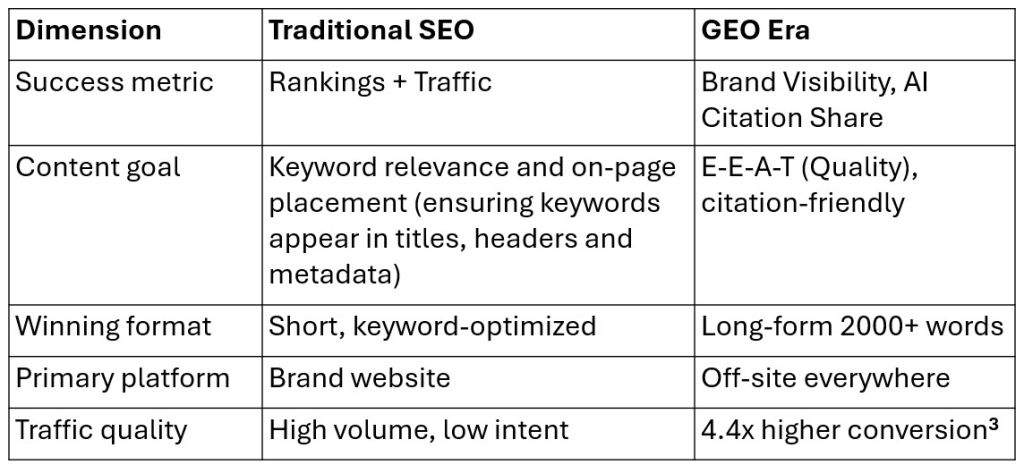
The Landscape Shift (How the Market has Changed)
| Dimension | Traditional SEO | GEO Era |
| Success metric | Rankings + Traffic | Brand Visibility, AI Citation Share |
| Content goal | Keyword relevance and on-page placement (ensuring keywords appear in titles, headers and metadata) | E-E-A-T (Quality), citation-friendly |
| Winning format | Short, keyword-optimized | Long-form 2000+ words |
| Primary platform | Brand website | Off-site everywhere |
| Traffic quality | High volume, low intent | 4.4x higher conversion3 |
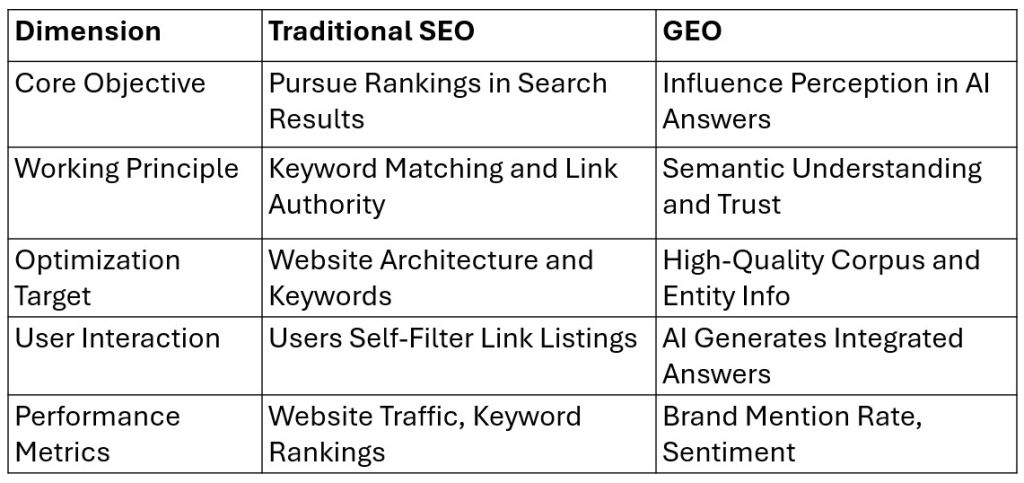
The Technical Framework (How the Logic has Changed)
| Dimension | Traditional SEO | GEO |
| Core Objective | Pursue Rankings in Search Results | Influence Perception in AI Answers |
| Working Principle | Keyword Matching and Link Authority | Semantic Understanding and Trust |
| Optimization Target | Website Architecture and Keywords | High-Quality Corpus and Entity Info |
| User Interaction | Users Self-Filter Link Listings | AI Generates Integrated Answers |
| Performance Metrics | Website Traffic, Keyword Rankings | Brand Mention Rate, Sentiment |
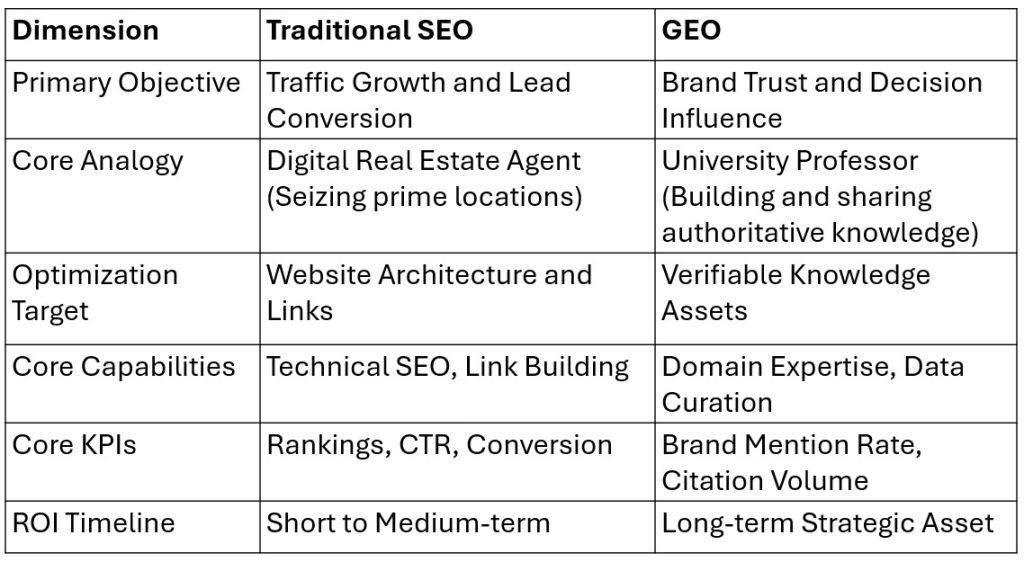
The Business Strategy (How our Actions must Change)
| Dimension | Traditional SEO | GEO |
| Primary Objective | Traffic Growth and Lead Conversion | Brand Trust and Decision Influence |
| Core Analogy | Digital Real Estate Agent
(Seizing prime locations) |
University Professor
(Building and sharing authoritative knowledge) |
| Optimization Target | Website Architecture and Links | Verifiable Knowledge Assets |
| Core Capabilities | Technical SEO, Link Building | Domain Expertise, Data Curation |
| Core KPIs | Rankings, CTR, Conversion | Brand Mention Rate, Citation Volume |
| ROI Timeline | Short to Medium-term | Long-term Strategic Asset |
The New Divide in LLMs
In 2026, the global digital landscape has undergone a fundamental shift: the transition from traditional SEO to Generative Engine Optimization (GEO). Presence is no longer just about search engine rankings. Today, success means being the cited source within AI-generated answers.
This evolution, however, has introduced a challenge: the widening divide between Western and Chinese LLMs. For global brands, understanding the scale of China’s AI search ecosystem is now a baseline requirement.
The Scale of the Chinese AI Boom (As of Dec 2025)
Market Adoption: China’s GenAI user base hit 602 million, representing a 141.7% YoY increase (adding 353 million users in just one year). Overall penetration reached 42.8%1.
Figure 1: Generative AI Popularity Rate
The GEO Opportunity: 76.0% of users use GenAI primarily for Q&A, making it the dominant use case. (Other applications include image/video generation at 47.8%, text generation at 37.6%, and work summaries/PPTs at 32.5%)1.
Figure 2: Purposes of Using Generative AI Products
Before purchasing products or services, over 80% of users use AI search to assist their purchase decisions, especially for products with high technical barriers and long decision-making cycles.2
TOP 6 Products/Services Where Users Use AI to Assist Search or Decision-Making2
AI Becomes a Middleman Between Enterprises and Buyers
In enterprise business operations, AI has become an absolutely necessary component.
AI Marketing Funnel Diagram
- Exposure & Reach: Users now discover and encounter brands directly through AI-generated answers.
- User Engagement: When making decisions, users rely on AI for brand introductions, product descriptions, and personalized recommendations.
- Purchase and Trust: AI becomes a new source of trust, with AI visibility becoming a key brand monitoring metric.
To succeed in this era, brands need a strategy that works for both traditional and AI search. In this blog, our experts break down the how discovery is changing, how trust is earned and the specific steps needed to bridge the AI divide:
- The Global Ecosystem: ChatGPT, Perplexity, Google AI Overviews, and Claude (trained predominantly on Western data and sources).
- China’s Ecosystem: ByteDance Doubao, DeepSeek, Alibaba Tongyi Qianwen, Tencent Yuanbao, Kimi, and Baidu ERNIE Bot.
Cracking the Code: The Rules of China’s GenAI Ecosystem
China’s AI landscape operates as an independent ecosystem built on its own logic, infrastructure, and algorithmic biases.
In the world of GEO, trust is the ultimate currency—and that trust is dictated entirely by where LLMs source their data. Chinese and global models are trained on extremely different data pools, which directly impacts how they perceive, prioritize, and recommend your brand. Understanding how these different AI systems are built is the key to building AI trust.
In China’s AI search era, your standalone corporate website is largely irrelevant.
The data infrastructure powering models like Doubao, DeepSeek, and ERNIE Bot do not prioritize independent brand domains. Instead, they heavily rely on China’s walled-garden platforms and highly localized content ecosystems.
Brands must undergo a mindset shift: abandoning traditional On-Site Optimization in favor of strategic Ecosystem Seeding. Rather than trying to pull users to a central website, brands must “plant” authoritative, AI-friendly content directly into the third-party platforms that LLMs use as primary training sets.
The Landscape Shift (How the Market has Changed)
The Technical Framework (How the Logic has Changed)
The Business Strategy (How our Actions must Change)
Ready to stay ahead of the curve?
Next in this series:
Key Players, Data Sources, and Trust Signals in China’s AI Ecosystem (Part 2 of 3)