
The 5-Step GEO Strategy for Winning Visibility in China’s AI Search Era (Part 3 of 3)
This article is Part 3 of a 3-part series and serves as a strategic guide for global brands entering China’s AI search ecosystem.
Part 2: Key Players, Data Sources, and Trust Signals in
China’s AI Ecosystem
Part 3: The 5-Step GEO Strategy for Winning Visibility in
China’s AI Search Era
The 5 Step Strategy
With Doubao and DeepSeek dominating the landscape, let’s use Doubao, the current market leader, as our standard to break down a proven GEO strategy.
Winning in Doubao requires reverse engineering AI. Here is our proprietary 5-step methodology:
Step 1: Prompt Expansion & Intent Parsing
We don’t just look at traditional search keywords; we identify high-frequency conversational prompts within your industry. We deconstruct these queries into a Prompt-to-Need Map, tracing the question to the user’s scenario, motivation and brand need. This allows us to pinpoint high-conversion prompts based on product features, emotional drivers, and specific use cases.
To understand how this approach adapts a standard keyword into an AI optimization strategy, let’s apply it to a specific B2B use case: Global Game Payments.
Here is how we build the Prompt-to-Need Map:
1. Question (The Raw AI Query)
Instead of targeting broad, low-intent terms like “game payment gateway,” we identify the complex, highly specific questions game publishers are actually asking AI when navigating global expansion.
What the user asks:
- “How to choose a global game payment gateway that supports mainstream local APMs and e-wallets?”
- “What are the best gaming Merchant of Record (MoR) providers that support multiple local currencies?”
- “Which game payment solutions comply with increasingly strict global payment data and tax regulations?”
2. Scenario (The Business Context)
We give the AI query a physical and operational context. Who is asking, and what is their current business bottleneck?
The Context: A gaming studio is preparing for a massive global rollout, targeting diverse regions like LATAM, APAC, and EMEA. They are actively mapping out their monetization infrastructure but have hit a wall: addressing the complexities of fragmented local payment habits, complex cross-border settlements, and shifting international laws.
3. Motivation (The Underlying Pain Point & Emotional Driver)
Why are they asking this? What is their true operational anxiety?
The Driver: They are terrified of making the wrong technical choice that could ruin their launch. They know generic payment gateways often flag gaming transactions as “high risk,” which can lead to frozen funds or high chargeback rates. Furthermore, they are game developers, not accountants—they are deeply anxious about drowning in global VAT/sales tax compliance or spending months of precious engineering time integrating dozens of local payment methods one by one. They want simplicity and security.
4. Brand Need (The Strategic Solution Intersection)
This is where we align your platform’s capabilities to the game publisher’s concerns, ensuring the AI recognizes your brand as the secure and reliable global partner.
The Solution: The game publisher doesn’t just need a generic “checkout button.” They need a comprehensive infrastructure. We map their needs to your unique value proposition: acting as a true Merchant of Record (MoR) to shoulder 100% of global tax and legal liabilities, offering a Unified API that instantly unlocks hundreds of localized payment methods (e-wallets, bank transfers, etc.), and providing enterprise-grade data compliance to guarantee secure, borderless transactions.
The Optimization Takeaway:
By running through this flow, we stop competing for highly saturated, traditional search terms. Instead, we optimize for the high-intent conversational space. When a confused Game Producer asks an AI, “Which payment platform is the easiest to integrate for a global game launch that also handles local taxes automatically?” the AI’s semantic understanding is fully primed to bypass generic gateways and recommend your brand as the definitive, developer-friendly platform.
How is China different? You must prioritize localized business scenarios and use cases that might simply not exist in the West, ensuring the AI recognizes your brand within the unique realities of the China market.
Step 2: AI Response Audit & Brand Gap Identification
We run the Top 50 industry-relevant prompts through Doubao to audit your current visibility. We analyze the exact text generated, the platforms cited, and the semantic sentiment surrounding your brand. Most importantly, we pinpoint critical blind spots where your brand is ignored, misunderstood, or mispositioned by the algorithm.
How is China different? Unlike Western LLMs which mostly draw from a unified “Open Web,” Chinese models have Walled Garden Blind Spots. An audit might show you are highly visible on Doubao (ByteDance) because of your Toutiao presence, but completely invisible on ERNIE Bot (Baidu). You aren’t auditing the “web”; you are auditing your visibility across competing ecosystems.
Step 3: Reverse-Engineering Citation Sources & Content Logic
For high-value prompts where your brand lacks positive visibility, we execute a deep-dive analysis into Doubao’s information sources. We quantify the frequency and weight of external sources (media, wikis, industry sites) to establish a Citation Penetration Rate (your brand’s share of AI citations). Furthermore, we analyze the cited content to understand its format, optimizing for the exact semantic density, title structures, and authoritative formats the AI prefers to learn from.
How is China different? In the West, you reverse-engineer “Authority” from independent websites (like a blog or a news site). In China, AI models don’t trust independent websites nearly as much. Instead, they trust official platforms.
You are identifying which specific platform (like Baidu Baike or Zhihu) the AI is using as its “Primary Dictionary” for your industry. If the AI doesn’t see you on that specific “Primary” platform, it doesn’t matter how many other websites mention you as the AI won’t cite you.
Step 4: AI-Friendly Content Creation & Ecosystem Seeding
Equipped with this data, we don’t just write articles; we craft content specifically designed for AI consumption. Using proven templates (e.g., Q&A formats, comparison tables, explanatory models), we build an AI optimized content hub. This highly structured content is then seeded directly into the high-authority platforms Doubao relies on, guaranteeing maximum exposure when the AI pulls its citations.
How is China different? In the West, GEO is “Platform Agnostic.” You create one high-quality, structured “Ultimate Guide” on your website, and through schema and clear headers, it becomes “readable” to Google, Perplexity, and ChatGPT simultaneously.
In China, GEO is “Platform-Locked.” Because the LLMs are owned by the platform giants (ByteDance, Baidu, Tencent), they have exclusive, deep-access training on the unique “Native Interaction Patterns” of their own apps.
To be cited by Doubao, the best strategy is to publish on ByteDance-owned platforms and use a “News-First” writing style that emphasizes immediate relevance.
Step 5: Dynamic Monitoring & Continuous Iteration
GEO is not set and forget. We establish a GEO Radar to track algorithm updates across Doubao and DeepSeek. We continuously monitor vital KPIs—such as Prompt mention rates, AI recommendation frequencies, and citation growth. Through ongoing A/B testing of content and quarterly adjustments, we ensure your brand maintains dominant presence in AI-generated answers.
How is China different? While Western practitioners are also moving to AI Share of Voice (SOV) metrics, the challenge in China is that SOV is fragmented by ownership. In the West, a high SOV is usually “universal” across the open web. In China, you can have a 90% SOV on Doubao (because of your strength on Toutiao) and 0% SOV on ERNIE Bot (because you lack a Baidu Baike presence). In China, you have to track your SOV separately for each platform.
The Mindset Shift – Brand Mention Over Traffic
Because Chinese LLMs rely so heavily on off-site content ecosystems, attempting to measure GEO success with traditional SEO dashboards is a fundamental mistake.
Let’s look at the technical reality. Traditional SEO is focused on tracking clicks and referral traffic. However, in the AI landscape, analytics are becoming a black box. Currently, DeepSeek no longer passes referral data from its citation links—if a user actually clicks a citation leading to your content, your analytics will simply record it as “Direct” traffic. While other LLMs (like Doubao) might still pass “Referral” tags, obsessing over traffic only tells part of the story.
Here is the hard truth of the AI Search era: users rarely click on citation sources. The AI is designed to synthesize and provide the complete answer directly within the chat interface, creating a “Zero-Click” environment.
Therefore, at our agency, we pivot the measurement away from outbound clicks. True GEO success is defined by AI (SOV). We focus entirely on whether your brand is prominently mentioned, positively framed, and actively recommended directly within the AI-generated results. If the AI is speaking highly of your brand, the conversion happens in the user’s mind before they ever click a link.
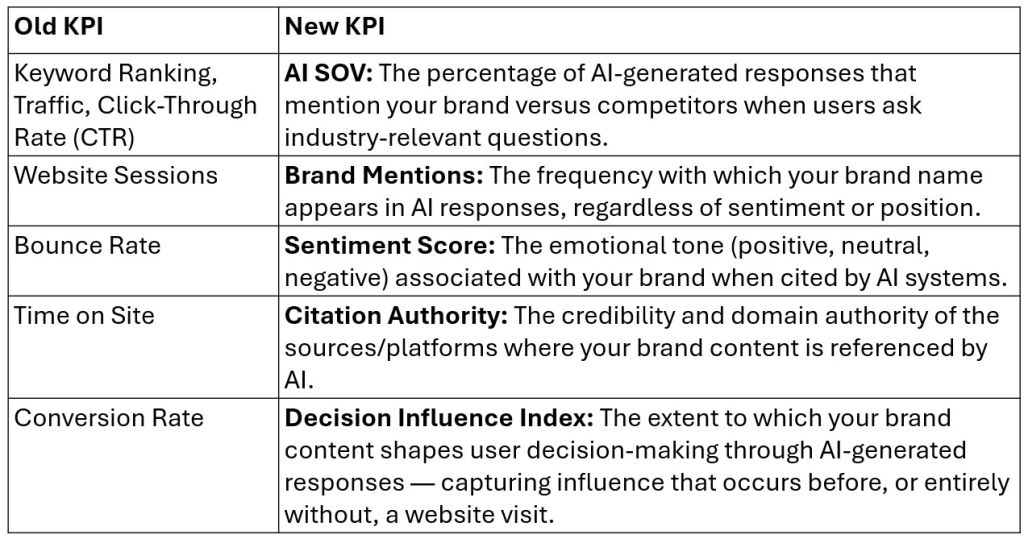
Redefining Success: Old vs. New KPIs
| Old KPI | New KPI |
| Keyword Ranking, Traffic, Click-Through Rate (CTR) | AI SOV: The percentage of AI-generated responses that mention your brand versus competitors when users ask industry-relevant questions. |
| Website Sessions | Brand Mentions: The frequency with which your brand name appears in AI responses, regardless of sentiment or position. |
| Bounce Rate | Sentiment Score: The emotional tone (positive, neutral, negative) associated with your brand when cited by AI systems. |
| Time on Site | Citation Authority: The credibility and domain authority of the sources/platforms where your brand content is referenced by AI. |
| Conversion Rate | Decision Influence Index: The extent to which your brand content shapes user decision-making through AI-generated responses — capturing influence that occurs before, or entirely without, a website visit. |
Conclusion: Bridging the AI Divide
We are seeing a shift where search is splitting into two paths. It’s no longer just about ranking #1 on a search page; it’s about making sure AI models also recognize you as the leading authority. The brands that succeed will be the ones that optimize for both human clicks and AI citations.
Success in China’s AI search ecosystem requires:
- Platform Fluency: Understanding where Doubao, DeepSeek, and ERNIE Bot source their knowledge
- Content Adaptation: Creating AI-friendly content in Simplified Chinese across walled-garden platforms
- Measurement Evolution: Shifting from traffic metrics to AI SOV and sentiment analysis
- Continuous Optimization: Monitoring algorithm changes and iterating content strategy quarterly
References:
- CNNIC《第57次中国互联网络发展状况统计报告》“The 57th Statistical Report on China’s Internet Development”: https://www.cnnic.net.cn/NMediaFile/2026/0304/MAIN1772588317069TUXN3827X8.pdf
- iresearch 2026 Engine Optimization (GEO) White Paper: https://report.iresearch.cn/report_pdf.aspx?id=4787
- AI search visitors worth 4.4x more than traditional organic traffic: https://ppc.land/ai-search-visitors-worth-4-4x-more-than-traditional-organic-traffic/
- CNNIC《生成式人工智能应用发展报告(2025)》“Report on the Development of Generative Artificial Intelligence Applications (2025)”: https://www.cnnic.net.cn/NMediaFile/2025/1021/MAIN1761038973801E6DI0GFPDE.pdf
- QuestMobile 2025 Annual Report on China’s Mobile Internet: https://www.questmobile.com.cn/research/report/2031215896219979777
- Top domains cited by AI search: Analysis based on 30M sources: https://peec.ai/blog/top-domains-cited-by-ai-search-analysis-based-on-30m-sources
The 5 Step Strategy
With Doubao and DeepSeek dominating the landscape, let’s use Doubao, the current market leader, as our standard to break down a proven GEO strategy.
Winning in Doubao requires reverse engineering AI. Here is our proprietary 5-step methodology:
Step 1: Prompt Expansion & Intent Parsing
We don’t just look at traditional search keywords; we identify high-frequency conversational prompts within your industry. We deconstruct these queries into a Prompt-to-Need Map, tracing the question to the user’s scenario, motivation and brand need. This allows us to pinpoint high-conversion prompts based on product features, emotional drivers, and specific use cases.
To understand how this approach adapts a standard keyword into an AI optimization strategy, let’s apply it to a specific B2B use case: Global Game Payments.
Here is how we build the Prompt-to-Need Map:
1. Question (The Raw AI Query)
Instead of targeting broad, low-intent terms like “game payment gateway,” we identify the complex, highly specific questions game publishers are actually asking AI when navigating global expansion.
What the user asks:
- “How to choose a global game payment gateway that supports mainstream local APMs and e-wallets?”
- “What are the best gaming Merchant of Record (MoR) providers that support multiple local currencies?”
- “Which game payment solutions comply with increasingly strict global payment data and tax regulations?”
2. Scenario (The Business Context)
We give the AI query a physical and operational context. Who is asking, and what is their current business bottleneck?
The Context: A gaming studio is preparing for a massive global rollout, targeting diverse regions like LATAM, APAC, and EMEA. They are actively mapping out their monetization infrastructure but have hit a wall: addressing the complexities of fragmented local payment habits, complex cross-border settlements, and shifting international laws.
3. Motivation (The Underlying Pain Point & Emotional Driver)
Why are they asking this? What is their true operational anxiety?
The Driver: They are terrified of making the wrong technical choice that could ruin their launch. They know generic payment gateways often flag gaming transactions as “high risk,” which can lead to frozen funds or high chargeback rates. Furthermore, they are game developers, not accountants—they are deeply anxious about drowning in global VAT/sales tax compliance or spending months of precious engineering time integrating dozens of local payment methods one by one. They want simplicity and security.
4. Brand Need (The Strategic Solution Intersection)
This is where we align your platform’s capabilities to the game publisher’s concerns, ensuring the AI recognizes your brand as the secure and reliable global partner.
The Solution: The game publisher doesn’t just need a generic “checkout button.” They need a comprehensive infrastructure. We map their needs to your unique value proposition: acting as a true Merchant of Record (MoR) to shoulder 100% of global tax and legal liabilities, offering a Unified API that instantly unlocks hundreds of localized payment methods (e-wallets, bank transfers, etc.), and providing enterprise-grade data compliance to guarantee secure, borderless transactions.
The Optimization Takeaway:
By running through this flow, we stop competing for highly saturated, traditional search terms. Instead, we optimize for the high-intent conversational space. When a confused Game Producer asks an AI, “Which payment platform is the easiest to integrate for a global game launch that also handles local taxes automatically?” the AI’s semantic understanding is fully primed to bypass generic gateways and recommend your brand as the definitive, developer-friendly platform.
How is China different? You must prioritize localized business scenarios and use cases that might simply not exist in the West, ensuring the AI recognizes your brand within the unique realities of the China market.
Step 2: AI Response Audit & Brand Gap Identification
We run the Top 50 industry-relevant prompts through Doubao to audit your current visibility. We analyze the exact text generated, the platforms cited, and the semantic sentiment surrounding your brand. Most importantly, we pinpoint critical blind spots where your brand is ignored, misunderstood, or mispositioned by the algorithm.
How is China different? Unlike Western LLMs which mostly draw from a unified “Open Web,” Chinese models have Walled Garden Blind Spots. An audit might show you are highly visible on Doubao (ByteDance) because of your Toutiao presence, but completely invisible on ERNIE Bot (Baidu). You aren’t auditing the “web”; you are auditing your visibility across competing ecosystems.
Step 3: Reverse-Engineering Citation Sources & Content Logic
For high-value prompts where your brand lacks positive visibility, we execute a deep-dive analysis into Doubao’s information sources. We quantify the frequency and weight of external sources (media, wikis, industry sites) to establish a Citation Penetration Rate (your brand’s share of AI citations). Furthermore, we analyze the cited content to understand its format, optimizing for the exact semantic density, title structures, and authoritative formats the AI prefers to learn from.
How is China different? In the West, you reverse-engineer “Authority” from independent websites (like a blog or a news site). In China, AI models don’t trust independent websites nearly as much. Instead, they trust official platforms.
You are identifying which specific platform (like Baidu Baike or Zhihu) the AI is using as its “Primary Dictionary” for your industry. If the AI doesn’t see you on that specific “Primary” platform, it doesn’t matter how many other websites mention you as the AI won’t cite you.
Step 4: AI-Friendly Content Creation & Ecosystem Seeding
Equipped with this data, we don’t just write articles; we craft content specifically designed for AI consumption. Using proven templates (e.g., Q&A formats, comparison tables, explanatory models), we build an AI optimized content hub. This highly structured content is then seeded directly into the high-authority platforms Doubao relies on, guaranteeing maximum exposure when the AI pulls its citations.
How is China different? In the West, GEO is “Platform Agnostic.” You create one high-quality, structured “Ultimate Guide” on your website, and through schema and clear headers, it becomes “readable” to Google, Perplexity, and ChatGPT simultaneously.
In China, GEO is “Platform-Locked.” Because the LLMs are owned by the platform giants (ByteDance, Baidu, Tencent), they have exclusive, deep-access training on the unique “Native Interaction Patterns” of their own apps.
To be cited by Doubao, the best strategy is to publish on ByteDance-owned platforms and use a “News-First” writing style that emphasizes immediate relevance.
Step 5: Dynamic Monitoring & Continuous Iteration
GEO is not set and forget. We establish a GEO Radar to track algorithm updates across Doubao and DeepSeek. We continuously monitor vital KPIs—such as Prompt mention rates, AI recommendation frequencies, and citation growth. Through ongoing A/B testing of content and quarterly adjustments, we ensure your brand maintains dominant presence in AI-generated answers.
How is China different? While Western practitioners are also moving to AI Share of Voice (SOV) metrics, the challenge in China is that SOV is fragmented by ownership. In the West, a high SOV is usually “universal” across the open web. In China, you can have a 90% SOV on Doubao (because of your strength on Toutiao) and 0% SOV on ERNIE Bot (because you lack a Baidu Baike presence). In China, you have to track your SOV separately for each platform.
The Mindset Shift – Brand Mention Over Traffic
Because Chinese LLMs rely so heavily on off-site content ecosystems, attempting to measure GEO success with traditional SEO dashboards is a fundamental mistake.
Let’s look at the technical reality. Traditional SEO is focused on tracking clicks and referral traffic. However, in the AI landscape, analytics are becoming a black box. Currently, DeepSeek no longer passes referral data from its citation links—if a user actually clicks a citation leading to your content, your analytics will simply record it as “Direct” traffic. While other LLMs (like Doubao) might still pass “Referral” tags, obsessing over traffic only tells part of the story.
Here is the hard truth of the AI Search era: users rarely click on citation sources. The AI is designed to synthesize and provide the complete answer directly within the chat interface, creating a “Zero-Click” environment.
Therefore, at our agency, we pivot the measurement away from outbound clicks. True GEO success is defined by AI (SOV). We focus entirely on whether your brand is prominently mentioned, positively framed, and actively recommended directly within the AI-generated results. If the AI is speaking highly of your brand, the conversion happens in the user’s mind before they ever click a link.
Redefining Success: Old vs. New KPIs
Conclusion: Bridging the AI Divide
We are seeing a shift where search is splitting into two paths. It’s no longer just about ranking #1 on a search page; it’s about making sure AI models also recognize you as the leading authority. The brands that succeed will be the ones that optimize for both human clicks and AI citations.
Success in China’s AI search ecosystem requires:
- Platform Fluency: Understanding where Doubao, DeepSeek, and ERNIE Bot source their knowledge
- Content Adaptation: Creating AI-friendly content in Simplified Chinese across walled-garden platforms
- Measurement Evolution: Shifting from traffic metrics to AI SOV and sentiment analysis
- Continuous Optimization: Monitoring algorithm changes and iterating content strategy quarterly
References:
- CNNIC《第57次中国互联网络发展状况统计报告》“The 57th Statistical Report on China’s Internet Development”: https://www.cnnic.net.cn/NMediaFile/2026/0304/MAIN1772588317069TUXN3827X8.pdf
- iresearch 2026 Engine Optimization (GEO) White Paper: https://report.iresearch.cn/report_pdf.aspx?id=4787
- AI search visitors worth 4.4x more than traditional organic traffic: https://ppc.land/ai-search-visitors-worth-4-4x-more-than-traditional-organic-traffic/
- CNNIC《生成式人工智能应用发展报告(2025)》“Report on the Development of Generative Artificial Intelligence Applications (2025)”: https://www.cnnic.net.cn/NMediaFile/2025/1021/MAIN1761038973801E6DI0GFPDE.pdf
- QuestMobile 2025 Annual Report on China’s Mobile Internet: https://www.questmobile.com.cn/research/report/2031215896219979777
- Top domains cited by AI search: Analysis based on 30M sources: https://peec.ai/blog/top-domains-cited-by-ai-search-analysis-based-on-30m-sources
Ready to stay ahead of the curve?
Previous in this series:
Key Players, Data Sources, and Trust Signals in China’s AI Ecosystem (Part 2 of 3)