
How Baidu’s AI Search Is Changing Marketing in China
Search in China has fundamentally transformed. Baidu didn’t just add AI features to its platform—it rebuilt search around artificial intelligence, turning queries into conversations and website listings into direct answers. The shift happened fast, and Chinese users adapted faster.
Today, when someone searches on Baidu, they’re increasingly engaging with AI-generated responses rather than clicking through to websites. They ask follow-up questions. They expect synthesized answers, not lists of links to explore. The traditional search behavior that marketers have optimized for over the past two decades is evolving into something entirely different.
For brands marketing in China, this creates a paradox: your content might be informing AI answers without driving any visibility or traffic back to you. The platform changed. User behavior shifted in response. Now your digital strategy needs to catch up.
How is Baidu building its AI ecosystem?
Baidu has been serious about artificial intelligence for years. In 2019, they introduced ERNIE 1.0 (Enhanced Representation through Knowledge Integration), and they haven’t stopped improving since. ERNIE Bot became widely available in 2023, followed by the flagship ERNIE 4.0 in October—a significant leap forward. By 2024, Baidu released ERNIE 4.0 Turbo, designed for faster responses and lower costs, making it easier to integrate across more products.

ERNIE Bot: https://ernie.baidu.com/
The evolution didn’t stop at building better models. Baidu systematically embedded AI across its entire ecosystem. According to Baidu’s 2024-2025 reporting, ERNIE Bot now has over 200 million users and handles hundreds of millions of daily prompts. It’s one of China’s leading consumer AI applications. The capabilities span consumer chatbots, developer APIs, search, AI cloud services, autonomous driving, and smart devices. Baidu’s strategy is clear: embed stronger multimodal and reasoning capabilities everywhere.
Then came a strategic pivot. Baidu recently announced the open-sourcing of 10 models from its Wenxin (ERNIE) 4.5 series. (Wenxin 文心 is the umbrella brand for Baidu’s ERNIE models.) Opening access sounds generous, but Baidu keeps the real advantage. They remain the original developer with deeper expertise, offering more optimized commercial versions and integrated solutions. It’s a smart play that reinforces their leadership in AI application within China.
What is Baidu’s AI market share in China?
The numbers back up Baidu’s dominance. According to Quest Mobile, Baidu holds the top position in AI search market share. This leadership comes from a comprehensive user base—significant PC presence plus vast active mobile users. The key driver? Seamless “in-app AI” integration within Baidu’s mobile ecosystem, particularly with ERNIE Bot.
In January 2026, Baidu announced that ERNIE Bot crossed the 200 million monthly active user mark, a major achievement. This rapid growth highlights not just Baidu’s clear lead in AI-powered search, but also the accelerating adoption of conversational AI in China’s digital ecosystem. This milestone is a sign of how quickly digital behavior is shifting toward AI-centric platforms.
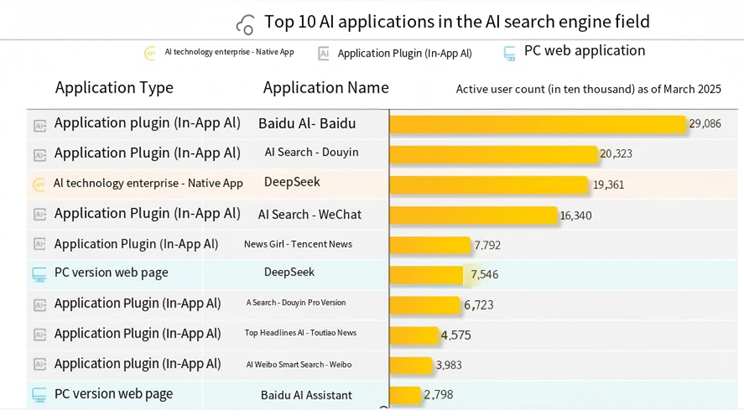
This extensive user base gives the Baidu App a distinct advantage in user acquisition, keeping it ahead of key competitors. Baidu holds the top spot. Social media platforms Douyin and WeChat rank second and third, primarily because of their massive active user counts combined with integrated AI access.
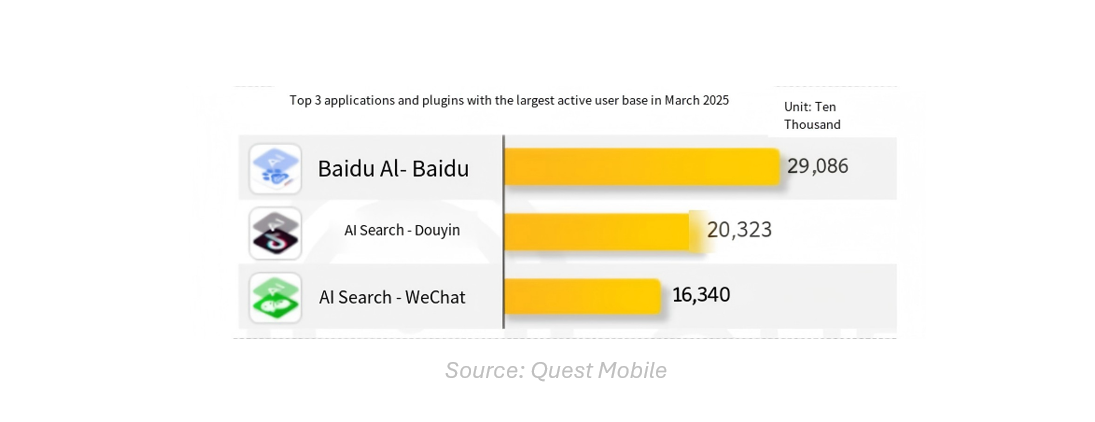
Independent validation confirms this leadership. The International Data Corporation (IDC) ranked Baidu’s AI Search first in overall score among general-purpose AI search products in China. Baidu achieved top rankings in two critical indicators: user data and technical capabilities. This positions Baidu as the dominant force in a critical area of future internet services.
The ecosystem integration allows Baidu to control not just how information is discovered, but how it’s created, curated, and consumed. For marketers, this means engaging with Baidu’s platforms isn’t optional—it’s essential for visibility.
The platform was ready. But would users actually change decades of search habits? The answer: faster than anyone expected.
Ready to maximize your digital marketing in China?
How are users responding to Baidu’s AI search?
User behavior data from the past year reveals two significant shifts in how people interact with Baidu search. These aren’t marginal changes—they represent fundamental alterations to search patterns that have direct implications for content visibility.
Shift 1: From Single Queries to Multi-Turn Conversations
Users didn’t wait long to change their habits. According to Quest Mobile, monthly AI usage time jumped significantly starting in February 2025, right when DeepSeek went viral and integrated into Baidu alongside ERNIE. This integration wasn’t limited to Baidu alone; Zhihu also saw substantial growth due to incorporating DeepSeek into its platform.
The numbers are striking. Zhihu reported a 144% month-over-month increase in AI usage frequency, with session volume surging too. People aren’t experimenting—they’re adopting AI as their default.
The key development: multi-turn conversations. Users engage with AI in back-and-forth exchanges where the system remembers context and builds on previous questions. This shows growing trust and familiarity with the technology.
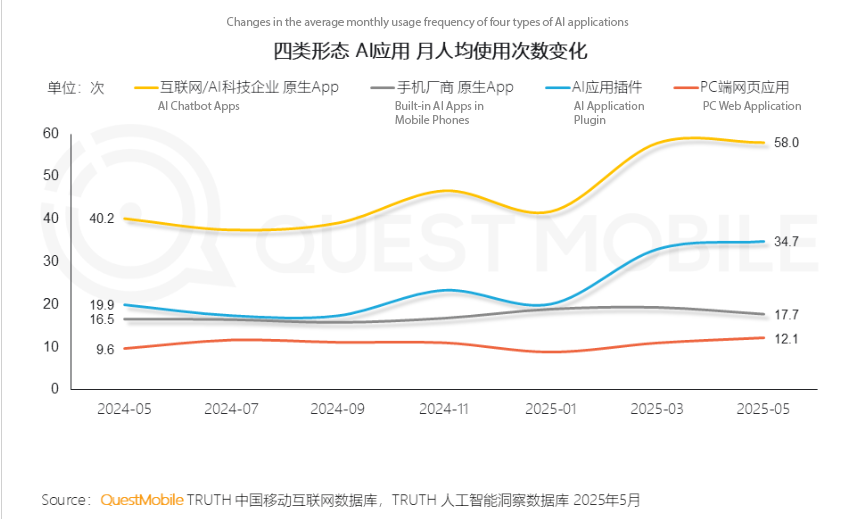
Monthly average usage trend of four types of AI
Shift 2: From Keyword Matching to Natural Language Questions
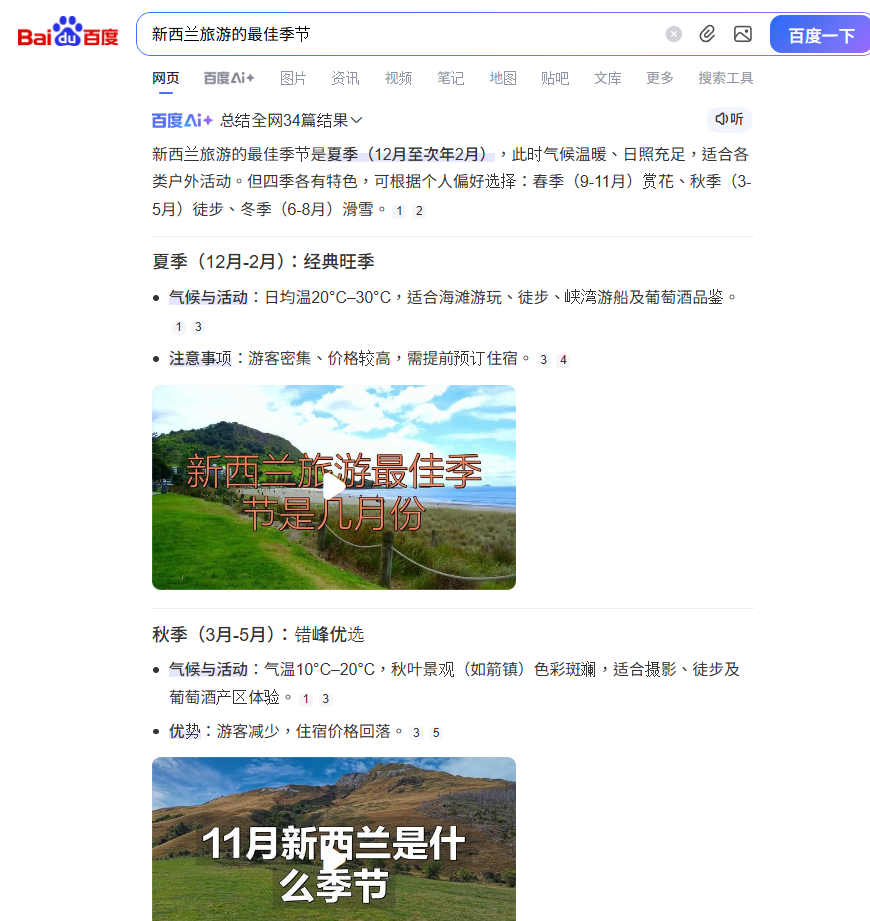
Understanding which queries trigger Baidu’s AI Chat matters more than ever. The patterns reveal users moving away from traditional keyword strings toward natural, conversational questions. Three distinct query types now dominate:
1. Question-form Keywords
(Example: Is it cold in winter in Shanghai?/ 上海的冬天冷吗)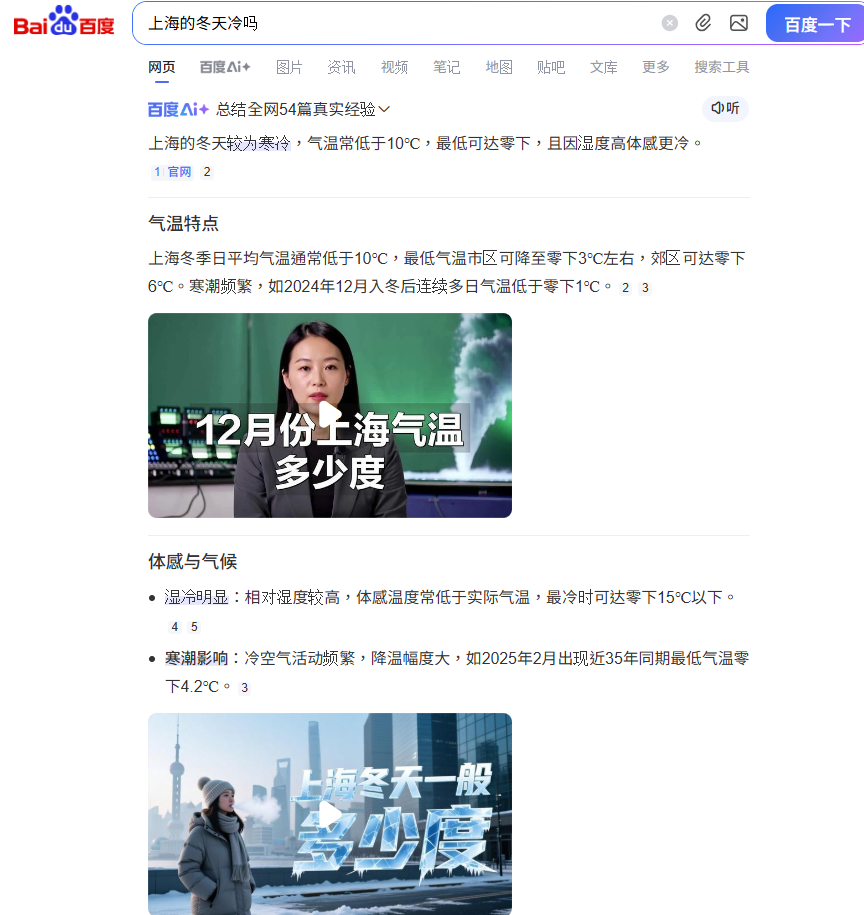
2. Scenario-based long-tail queries
(Example: The best season for New Zealand tourism/ 新西兰旅游的最佳季节)
3. High-frequency trigger words
(Example: Recommended brands for power banks/ 充电宝品牌推荐)
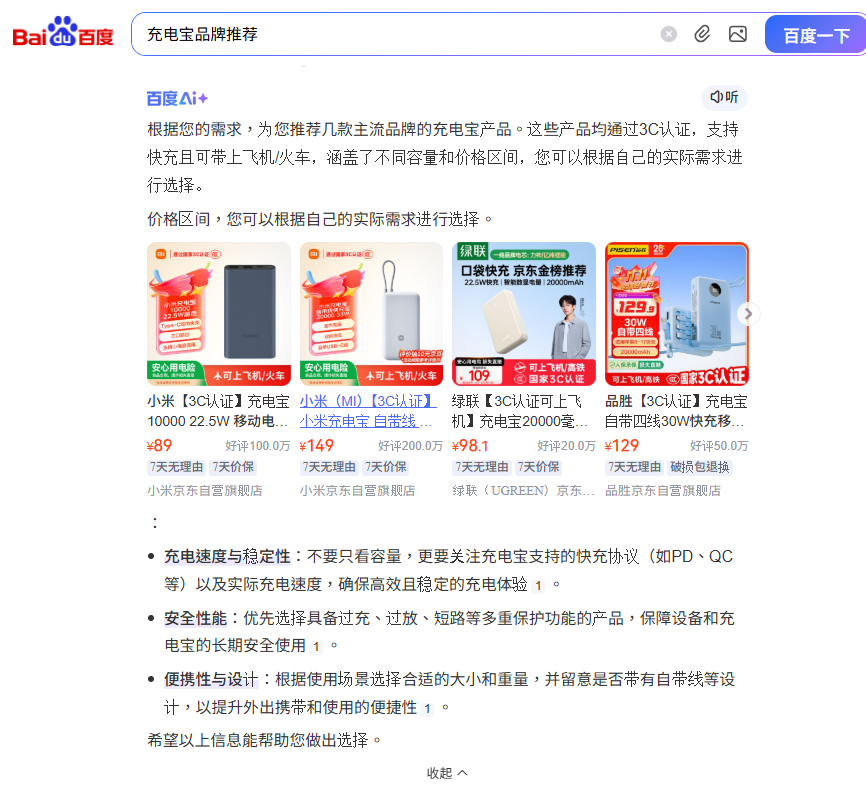
The Combined Impact: Zero-Click Dominance
These two behavioral shifts create a critical consequence for marketers: users are getting answers without leaving Baidu’s ecosystem. AI-generated responses appear directly on the results page, and when users can engage in multi-turn conversations using natural language, they have less reason to click through to external websites.
The data confirms this. On Baidu, users increasingly obtain information directly from the results page, resulting in a noticeable reduction in clicks to external websites.
Takeaway: Users increasingly obtain answers directly from Baidu’s results page, resulting in fewer clicks to external websites—a shift known as zero-click search.
Suggested reading: The Era of Zero-Click Searches and How to Adapt Your SEO Strategy
Bing’s Different Dynamic in China
Bing in China tells a different story—outbound clicks haven’t declined as much because Bing Copilot’s AI features have limited availability in the Chinese market. Users still need to click through for comprehensive information.
Users changed their behavior faster than anyone expected. Now marketers need to catch up. The question becomes: what does this mean for your strategy?
What does Baidu’s AI search mean for marketers?
The behavioral shifts create immediate consequences for how marketing works in China. When users get answers directly from Baidu instead of clicking through to websites, the entire foundation of SEM shifts.
Visibility Without Traffic
Your content might be informing AI responses without driving any recognition back to your brand. Baidu’s AI synthesizes information from multiple sources, generates an answer, and users move on—often without ever knowing which brands contributed to that answer.
Your content still matters. The AI needs authoritative sources to generate quality responses. But the relationship between content quality and business outcomes has fundamentally changed. You’re no longer optimizing for clicks. You’re optimizing for influence within an AI’s knowledge base.
From Keywords to Knowledge Authority
Content value has shifted from keyword density to demonstrable knowledge authority. Businesses need to provide verifiable data, publish authoritative white papers, and become definitive, trustworthy sources of information in their respective fields.
The technical implementation has evolved too. SEO has moved from simple page ranking competition to achieving knowledge graph penetration. This requires entity-based optimization and structured data implementation (schema markup). The goal: ensure Baidu’s AI can directly understand and integrate your brand’s information.
New Metrics for a New Reality
Performance evaluation now extends beyond traditional click conversions. Brands must increasingly measure their success by AI citation rates and answer coverage—actively monitoring how frequently their content is directly referenced, cited, or used to generate answers within AI-driven search results, even if it doesn’t result in a direct click to their website.
SEO Tools like Dragon Metrics now monitor what appears in AI results, providing visibility into how your content performs within AI-generated responses.
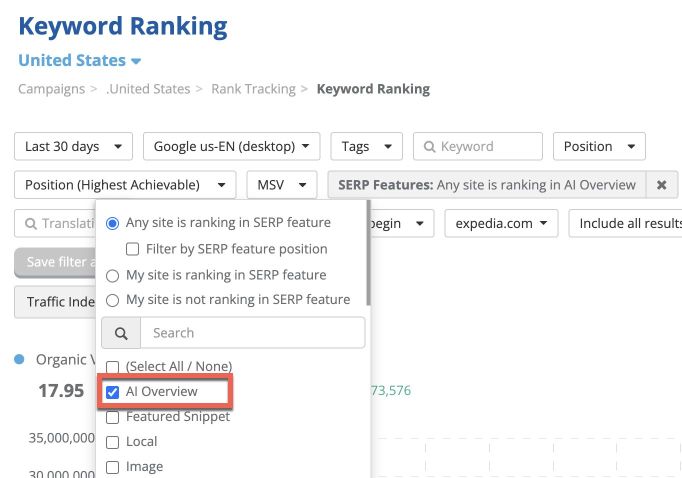
Screenshot from Dragon Metrics
Playing by Baidu’s Rules
Baidu strategically places emphasis on retaining user traffic within its proprietary ecosystem, granting preferential visibility and indexing to content published directly on its own platforms. To effectively maintain and improve brand visibility, businesses should strategically leverage Baidu platforms such as Baijiahao and Baidu Wenku to establish an authoritative brand presence. This approach ensures content is optimally discoverable and prioritized by Baidu’s AI algorithms.
What Actually Works
Three strategies consistently improve performance in AI-driven search:
Optimize for Semantic Search
AI-driven search engines focus on understanding the context and intent behind search queries rather than just matching keywords. Ensure your content is contextually relevant, comprehensive, and directly addresses the potential questions and needs of users.
AI in Action
Baidu’s AI search has fundamentally shifted to conversational, zero-click answers. At The Egg, we specialize in adapting content and SEO strategies for this AI-driven landscape. This ensures your brand maintains influence and visibility within Baidu’s ecosystem.
Focus on Quality Content
Rather than just adapting content for AI algorithms, marketers should aim to influence how these algorithms perceive quality. AI is highly capable of recognizing authoritative and valuable content, so your goal should be to create in-depth, informative, and engaging material that sets standards. By proactively focusing on delivering real value to readers, you not only improve your chances of being favoured by AI-driven search engines but also play a part in shaping how AI defines high-quality content.
Leverage Structured Data
Utilize structured data (schema markup) to enhance the ability of AI algorithms to interpret the content on your pages more effectively. Applying schema markup can help ensure that AI comprehends your content’s context and structure, potentially leading to improved search visibility and user engagement.
The landscape has changed. Traditional tactics need adjustment. The question now: what specific actions should you take?
The Way Forward: Adapting to AI Search
Baidu’s rapid transformation from a traditional search engine to an AI-powered answer platform has fundamentally changed the SEO playbook in China. Traditional strategies built on driving traffic to external websites now face fundamental limitations, as Baidu’s deep vertical integration reinforces zero-click search behavior. Success requires moving beyond old keyword queries and prioritizing visibility and presence directly within the Baidu ecosystem with content that the AI systems can easily interpret and cite.
Looking ahead, this evolution will only accelerate. Marketers need to monitor the following key developments:
- Deeper LLM Integration: Baidu is embedding ERNIE Bot across its ecosystem, shifting to conversational and zero-click search. This evolution impacts content delivery, user experience, and brand presence.
- Multi-Agent and Multimodal Evolution: Baidu is advancing towards multi-agent systems and multimodal interaction, targeting autonomous AI processes beyond text engagement.
- Open-Source Strategy: Baidu’s open-source initiatives are expanding its AI ecosystem, promoting cloud services and solidifying its role as a foundational AI infrastructure provider.
- Competitive Landscape Intensification: Platforms like Douyin and WeChat are transforming into AI-driven information hubs, challenging traditional search dynamics and influencing where users seek answers.
These developments will continue reshaping how content is discovered, consumed, and monetized across China’s digital landscape.
China’s search landscape has entered a new era. The question isn’t whether to adapt—it’s how quickly you can implement strategies that work in an AI-driven environment.