
How to Audit Your AI Visibility and Optimize for AI Overview and LLMs like ChatGPT in 30 Minutes
The landscape of search is transforming at unprecedented speed. Google’s AI Overview now appears in around 16% of searches globally, while ChatGPT processes billions of queries monthly. Yet most businesses have no idea whether their content appears in these AI-powered results. Traditional SEO tools like Google Search Console don’t track ChatGPT citations or AI Overview appearances. This means you’re flying blind in the fastest-growing segment of search. The solution? A focused 30-minute audit that reveals exactly where you stand, followed by six tactical optimizations that increase your chances of appearing in AI search results.
Why AI Visibility Audits Are Different from Traditional SEO Audits
Traditional SEO audits focus on rankings, backlinks, and technical performance. AI visibility requires a slightly different approach because AI engines don’t rank pages—they synthesize information from multiple sources and cite the most relevant, authoritative content. You’re no longer optimizing to appear in position one. You’re optimizing to be referenced and quoted alongside other trusted sources.
The challenge is measurement. You need to upgrade your measurement to assess whether ChatGPT mentioned your business or if your content appears in Google’s AI Overview. Below, we offer a specialized audit framework designed specifically for the AI search era.
The 30-Minute AI Visibility Audit Framework
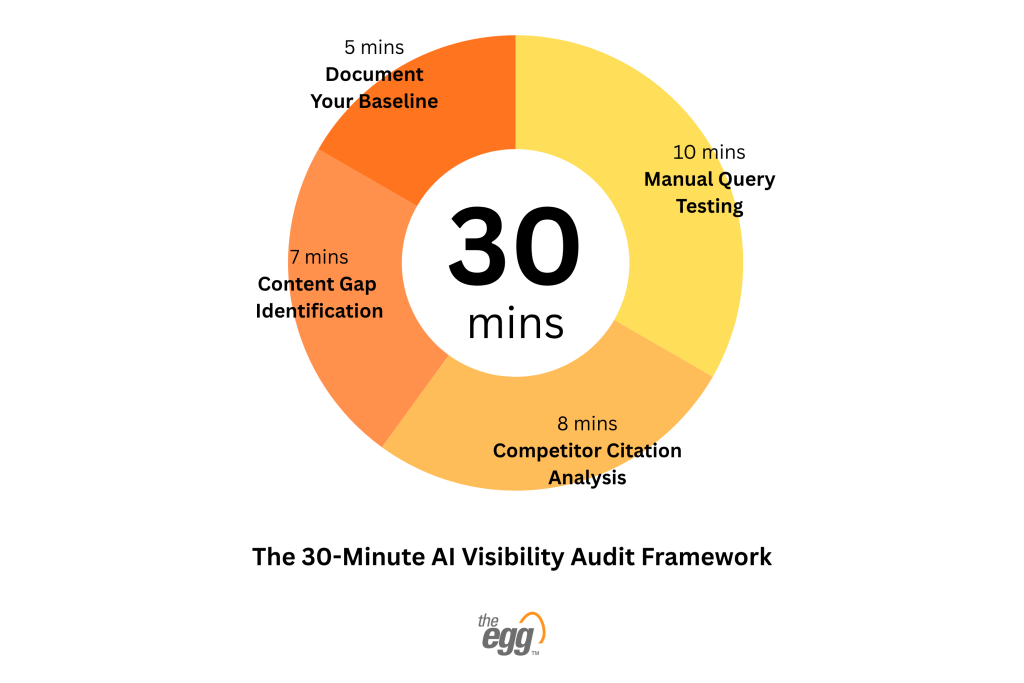
Step 1: Manual Query Testing (10 minutes)
Start by identifying keywords that trigger AI Overview and prompts that reflect how your audience searches on LLMs like ChatGPT. Our previous article walks you through how you can do that.
Prompts should include your primary service offerings, industry questions, and problem-solution searches your ideal clients use. For example, if you’re a digital marketing agency, test queries like “Could you recommend a good digital marketing agency for B2B?”
Test each query in ChatGPT, Perplexity, and Google AI Overview. Take screenshots and document what appears. The critical questions: Does your business get mentioned? Does your content get cited?
If you don’t want to go the manual route, you can automate this process using paid tools like Dragon Metrics, SEMRush, Ahrefs that will capture sites that are cited in AI Overview and LLMs like ChatGPT based on a set of keywords or prompts.
Step 2: Competitor Citation Analysis (8 minutes)
Refer back to your screenshots and documentations of LLM chats and Google AI Overview answers from Step 1, but this time focus exclusively on competitor mentions. Identify which competitors appear across different AI platforms and what content formats get cited. Are they appearing because of detailed how-to guides? Original research? Case studies with specific data points?
For example, when we tested “how to optimize for Google AI Overview,” ChatGPT and Google AI Overview cited several industry blogs but zero agency websites. This immediately revealed a content gap, presenting a major citation opportunity for us.
Pattern recognition also matters here. If a competitor appears in 4 out of 5 AI platforms for your core queries, analyze what they’re doing differently. In our analysis, we found that the competitors who dominated AI results were those who published comprehensive, regularly updated guides with specific step-by-step processes—exactly the citation-worthy format AI engines prefer.
Step 3: Content Gap Identification (7 minutes)
Compare what AI engines cite against what you currently have published. Look specifically for question-answer formats, data-rich content with statistics and dates, and structured information that’s easy for AI to extract and synthesize.
Ask yourself: Do you have content that directly answers the queries you tested? Are you providing the depth and structure that AI engines favor? Most businesses discover significant gaps, finding that they have service pages and blog posts, but lack the comprehensive, authoritative guides that earn AI citations.
Step 4: Document Your Baseline (5 minutes)
| Query | ChatGPT Result | AI Overview Result | Your Appearance (Y/N) | Competitor Mentioned |
This becomes your benchmark for measuring improvement over time. Include the audit date and set a calendar reminder to re-test monthly. Without this baseline, you can’t measure the impact of your optimization efforts.
Now that you know where you stand, here’s how to improve your AI visibility through tactical on-page optimizations.
6 Tactical On-Page Optimizations That Increase AI Visibility
In short, you can increase your AI visibility through these six key tactics:
- Structure content using direct question-answer formats.
- Implement schema markup like FAQ and Article schema to help AI engines extract data.
- Include specific data points and verifiable statistics with dates.
- Optimize for entity recognition through consistent company formatting and authoritative links.
- Create comprehensive content (1,500–2,500 words) covering multiple perspectives and related sub-topics.
- Date-stamp and measure your performance and citation frequency monthly.
1. How Should You Structure Content to Increase AI Visibility?
AI engines prioritize clear, direct answers to user queries. Content that explicitly asks questions and provides concise, well-structured answers increases your citation probability significantly because that information is easily parsed and extracted by retrieval systems.
The implementation is straightforward: Front-load the answer before expanding on details, add FAQ sections to existing pages, use headings formatted as questions, then provide direct answers in the first 2-3 sentences below each heading.
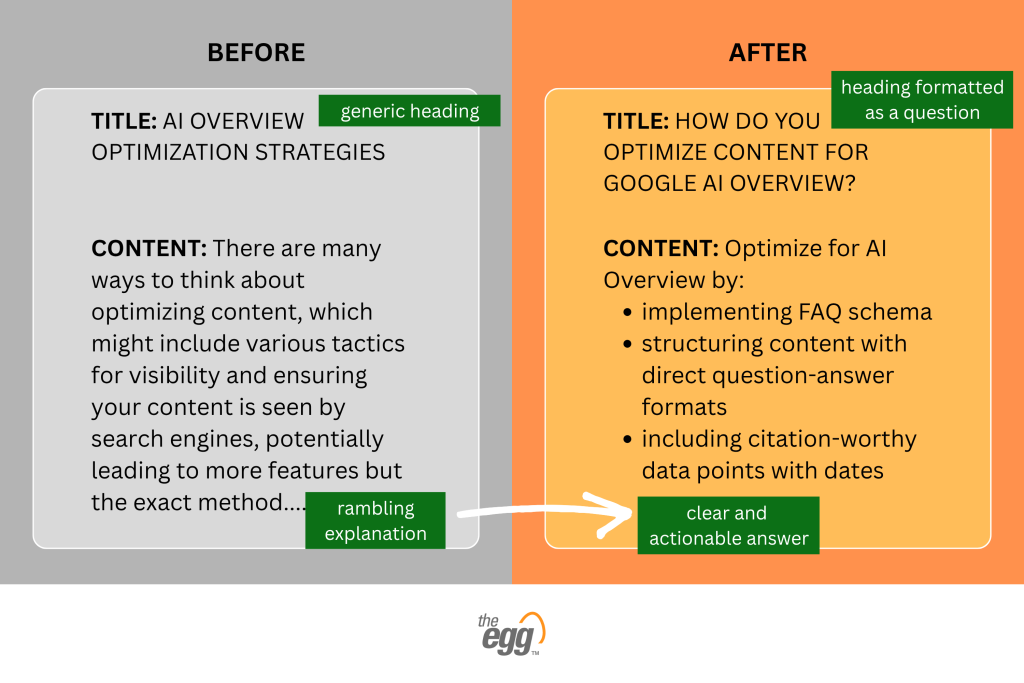
Consider the transformation from “AI Overview Optimization Strategies” as a generic heading with rambling explanation to “How Do You Optimize Content for Google AI Overview?” followed by a clear, actionable answer: “Optimize for AI Overview by implementing FAQ schema, structuring content with direct question-answer formats, and including citation-worthy data points with dates.” The difference in AI comprehension and citation probability is substantial.
Start with your five highest-traffic pages first. The combination of existing authority plus improved structure delivers faster results than optimizing lower-visibility content.
2. How Does Schema Markup Help AI Engines Understand Content?
Structured data helps AI engines understand, extract, and confidently cite your information. Schema provides explicit signals about content type, structure, and reliability that AI systems use when evaluating source quality.
Schemas like FAQ schema, HowTo schema, and Article schema support how AI engines consume and reference content. Implement FAQ schema on service pages and comprehensive guides, then validate using Google’s Rich Results Test. Even if rich results don’t appear in traditional search, the structured data benefits AI engine comprehension and citation confidence.
The technical implementation is accessible, as most modern content management systems offer schema plugins, or you can add JSON-LD markup directly to your page header. The investment of 15-20 minutes per page pays dividends in AI visibility.
3. What Makes Content Citation-Worthy for AI Engines?
AI engines cite specific, verifiable information. Original research, case study results, and dated benchmarks provide the concrete facts AI systems prefer when synthesizing answers for users.
Instead of writing “Our clients see significant improvements,” transform it to “Our analysis of 47 client websites between January and March 2026 showed a 3.4X increase in AI Overview appearances after implementing structured FAQ content.” The specificity—number of clients, timeframe, exact multiplier, clear cause-effect relationship—makes this citation-worthy in a way generic claims never achieve.
Make your data easily citeable by formatting it clearly, including methodology notes, and using consistent date formats. AI engines favor transparency and verifiable information over vague success claims. This approach simultaneously builds credibility with human readers and citation probability with AI systems.
4. How Can You Improve Entity Recognition for AI Search?
AI systems understand entities—people, companies, locations, concepts—better than disconnected keywords. Clear entity signals improve your chances of accurate citation and proper attribution when AI engines reference your content.
Include your full company name with consistent formatting across all pages. Add structured “About” sections that clearly define who you are and what you do. Link to authoritative entity sources like your LinkedIn company page, industry associations, or relevant Wikipedia entries. Use consistent terminology when describing your expertise areas to reinforce entity recognition.
An entity-optimized bio reads: “Sarah Mitchell is the founder of Velocity Digital, a Rotterdam-based marketing agency specializing in AI search optimization (GEO). She has led SEO strategy for 150+ European technology companies since 2018.” This clearly establishes entity relationships, location, expertise, and authority markers that AI systems use to evaluate source credibility.
5. How Can Comprehensive Content Improve Your Chances of Being Cited?
Google AI Overview and LLMs like ChatGPT typically break complex user queries into multiple smaller sub-queries, searching each separately, then synthesizing information from various sources into a single comprehensive response. This behavior is called “query fan-out”.
Comprehensive content that covers topics from multiple angles and addresses the query fan-out possibilities positions you as the likely source that gets referenced or cited for a query.
For instance, go beyond surface-level coverage in your blog. Include benefits AND limitations, compare different approaches, address common objections, and provide context for various use cases. This multi-perspective depth signals expertise and balanced analysis, qualities AI engines prioritize when selecting citation sources.
Long-form content with 1,500-2,500 words allows sufficient depth while maintaining focus and readability. Structure with clear sections, comparative tables where relevant, and progressive information disclosure that builds understanding systematically. This structure matches how AI engines prefer to extract and synthesize information, which translates directly to citation frequency.
6. Why Should You Update and Date-Stamp Content Regularly?
AI engines tend to favor current information. Visible dates signal content freshness and relevance, increasing citation confidence when AI systems evaluate competing sources.
Add clear publication dates and “last updated” timestamps to all significant content. Implement schema markup for datePublished and dateModified. Commit to refreshing statistics, examples, and screenshots quarterly for pillar content that drives business value.
A dual approach, such as combining schema markup with visible “Last Updated: March 2026” text near your title serves both AI engines (through structured data) and human readers (through visible trust signals). The technical implementation takes minutes, but the impact on perceived currency and AI citation probability is significant.
Measuring Your AI Visibility Improvements
In order to evaluate performance, perform monthly re-testing using your original query set. Track three key metrics: brand mention frequency or appearance rate (what percentage of test queries mention your brand in the answer) and citation frequency across different AI platforms.
Secondary indicators include referral traffic from AI platforms when trackable through analytics and increases in branded search volume as AI exposure builds awareness.
The iterative approach works: test your baseline, implement optimizations systematically, measure changes monthly, and refine based on what drives citation and brand mention improvements. This disciplined methodology separates strategic AI visibility efforts from random optimization attempts that waste resources without delivering measurable results.
From Audit to Action
Your 30-minute audit provides strategic clarity on exactly where you stand in the AI search landscape. The six tactical optimizations give you an actionable roadmap for improvement, prioritized by implementation effort and expected impact.
Start with your audit today by blocking 30 minutes this week. Then implement one optimization immediately, beginning with question-answer content restructuring on your highest-traffic pages. This quick win builds momentum and demonstrates value before you invest in more technical implementations like schema markup.
AI visibility isn’t a future consideration, it’s the competitive advantage that early adopters are capturing right now. The businesses that appear consistently in ChatGPT responses and Google AI Overview are building brand authority and capturing demand in the fastest-growing search channel. This 30-minute audit and optimization tactics are the first step toward joining them.
Why AI Visibility Audits Are Different from Traditional SEO Audits
Traditional SEO audits focus on rankings, backlinks, and technical performance. AI visibility requires a slightly different approach because AI engines don’t rank pages—they synthesize information from multiple sources and cite the most relevant, authoritative content. You’re no longer optimizing to appear in position one. You’re optimizing to be referenced and quoted alongside other trusted sources.
The challenge is measurement. You need to upgrade your measurement to assess whether ChatGPT mentioned your business or if your content appears in Google’s AI Overview. Below, we offer a specialized audit framework designed specifically for the AI search era.
The 30-Minute AI Visibility Audit Framework
Step 1: Manual Query Testing (10 minutes)
Start by identifying keywords that trigger AI Overview and prompts that reflect how your audience searches on LLMs like ChatGPT. Our previous article walks you through how you can do that.
Prompts should include your primary service offerings, industry questions, and problem-solution searches your ideal clients use. For example, if you’re a digital marketing agency, test queries like “Could you recommend a good digital marketing agency for B2B?”
Test each query in ChatGPT, Perplexity, and Google AI Overview. Take screenshots and document what appears. The critical questions: Does your business get mentioned? Does your content get cited?
If you don’t want to go the manual route, you can automate this process using paid tools like Dragon Metrics, SEMRush, Ahrefs that will capture sites that are cited in AI Overview and LLMs like ChatGPT based on a set of keywords or prompts.
Step 2: Competitor Citation Analysis (8 minutes)
Refer back to your screenshots and documentations of LLM chats and Google AI Overview answers from Step 1, but this time focus exclusively on competitor mentions. Identify which competitors appear across different AI platforms and what content formats get cited. Are they appearing because of detailed how-to guides? Original research? Case studies with specific data points?
For example, when we tested “how to optimize for Google AI Overview,” ChatGPT and Google AI Overview cited several industry blogs but zero agency websites. This immediately revealed a content gap, presenting a major citation opportunity for us.
Pattern recognition also matters here. If a competitor appears in 4 out of 5 AI platforms for your core queries, analyze what they’re doing differently. In our analysis, we found that the competitors who dominated AI results were those who published comprehensive, regularly updated guides with specific step-by-step processes—exactly the citation-worthy format AI engines prefer.
Step 3: Content Gap Identification (7 minutes)
Compare what AI engines cite against what you currently have published. Look specifically for question-answer formats, data-rich content with statistics and dates, and structured information that’s easy for AI to extract and synthesize.
Ask yourself: Do you have content that directly answers the queries you tested? Are you providing the depth and structure that AI engines favor? Most businesses discover significant gaps, finding that they have service pages and blog posts, but lack the comprehensive, authoritative guides that earn AI citations.
Step 4: Document Your Baseline (5 minutes)

This becomes your benchmark for measuring improvement over time. Include the audit date and set a calendar reminder to re-test monthly. Without this baseline, you can’t measure the impact of your optimization efforts.
Now that you know where you stand, here’s how to improve your AI visibility through tactical on-page optimizations.
6 Tactical On-Page Optimizations That Increase AI Visibility
In short, you can increase your AI visibility through these six key tactics:
- Structure content using direct question-answer formats.
- Implement schema markup like FAQ and Article schema to help AI engines extract data.
- Include specific data points and verifiable statistics with dates.
- Optimize for entity recognition through consistent company formatting and authoritative links.
- Create comprehensive content (1,500–2,500 words) covering multiple perspectives and related sub-topics.
- Date-stamp and measure your performance and citation frequency monthly.
1. How Should You Structure Content to Increase AI Visibility?
AI engines prioritize clear, direct answers to user queries. Content that explicitly asks questions and provides concise, well-structured answers increases your citation probability significantly because that information is easily parsed and extracted by retrieval systems.
The implementation is straightforward: Front-load the answer before expanding on details, add FAQ sections to existing pages, use headings formatted as questions, then provide direct answers in the first 2-3 sentences below each heading.
Consider the transformation from “AI Overview Optimization Strategies” as a generic heading with rambling explanation to “How Do You Optimize Content for Google AI Overview?” followed by a clear, actionable answer: “Optimize for AI Overview by implementing FAQ schema, structuring content with direct question-answer formats, and including citation-worthy data points with dates.” The difference in AI comprehension and citation probability is substantial.
Start with your five highest-traffic pages first. The combination of existing authority plus improved structure delivers faster results than optimizing lower-visibility content.
2. How Does Schema Markup Help AI Engines Understand Content?
Structured data helps AI engines understand, extract, and confidently cite your information. Schema provides explicit signals about content type, structure, and reliability that AI systems use when evaluating source quality.
Schemas like FAQ schema, HowTo schema, and Article schema support how AI engines consume and reference content. Implement FAQ schema on service pages and comprehensive guides, then validate using Google’s Rich Results Test. Even if rich results don’t appear in traditional search, the structured data benefits AI engine comprehension and citation confidence.
The technical implementation is accessible, as most modern content management systems offer schema plugins, or you can add JSON-LD markup directly to your page header. The investment of 15-20 minutes per page pays dividends in AI visibility.
3. What Makes Content Citation-Worthy for AI Engines?
AI engines cite specific, verifiable information. Original research, case study results, and dated benchmarks provide the concrete facts AI systems prefer when synthesizing answers for users.
Instead of writing “Our clients see significant improvements,” transform it to “Our analysis of 47 client websites between January and March 2026 showed a 3.4X increase in AI Overview appearances after implementing structured FAQ content.” The specificity—number of clients, timeframe, exact multiplier, clear cause-effect relationship—makes this citation-worthy in a way generic claims never achieve.
Make your data easily citeable by formatting it clearly, including methodology notes, and using consistent date formats. AI engines favor transparency and verifiable information over vague success claims. This approach simultaneously builds credibility with human readers and citation probability with AI systems.
4. How Can You Improve Entity Recognition for AI Search?
AI systems understand entities—people, companies, locations, concepts—better than disconnected keywords. Clear entity signals improve your chances of accurate citation and proper attribution when AI engines reference your content.
Include your full company name with consistent formatting across all pages. Add structured “About” sections that clearly define who you are and what you do. Link to authoritative entity sources like your LinkedIn company page, industry associations, or relevant Wikipedia entries. Use consistent terminology when describing your expertise areas to reinforce entity recognition.
An entity-optimized bio reads: “Sarah Mitchell is the founder of Velocity Digital, a Rotterdam-based marketing agency specializing in AI search optimization (GEO). She has led SEO strategy for 150+ European technology companies since 2018.” This clearly establishes entity relationships, location, expertise, and authority markers that AI systems use to evaluate source credibility.
5. How Can Comprehensive Content Improve Your Chances of Being Cited?
Google AI Overview and LLMs like ChatGPT typically break complex user queries into multiple smaller sub-queries, searching each separately, then synthesizing information from various sources into a single comprehensive response. This behavior is called “query fan-out”.
Comprehensive content that covers topics from multiple angles and addresses the query fan-out possibilities positions you as the likely source that gets referenced or cited for a query.
For instance, go beyond surface-level coverage in your blog. Include benefits AND limitations, compare different approaches, address common objections, and provide context for various use cases. This multi-perspective depth signals expertise and balanced analysis, qualities AI engines prioritize when selecting citation sources.
Long-form content with 1,500-2,500 words allows sufficient depth while maintaining focus and readability. Structure with clear sections, comparative tables where relevant, and progressive information disclosure that builds understanding systematically. This structure matches how AI engines prefer to extract and synthesize information, which translates directly to citation frequency.
6. Why Should You Update and Date-Stamp Content Regularly?
AI engines tend to favor current information. Visible dates signal content freshness and relevance, increasing citation confidence when AI systems evaluate competing sources.
Add clear publication dates and “last updated” timestamps to all significant content. Implement schema markup for datePublished and dateModified. Commit to refreshing statistics, examples, and screenshots quarterly for pillar content that drives business value.
A dual approach, such as combining schema markup with visible “Last Updated: March 2026” text near your title serves both AI engines (through structured data) and human readers (through visible trust signals). The technical implementation takes minutes, but the impact on perceived currency and AI citation probability is significant.
Measuring Your AI Visibility Improvements
In order to evaluate performance, perform monthly re-testing using your original query set. Track three key metrics: brand mention frequency or appearance rate (what percentage of test queries mention your brand in the answer) and citation frequency across different AI platforms.
Secondary indicators include referral traffic from AI platforms when trackable through analytics and increases in branded search volume as AI exposure builds awareness.
The iterative approach works: test your baseline, implement optimizations systematically, measure changes monthly, and refine based on what drives citation and brand mention improvements. This disciplined methodology separates strategic AI visibility efforts from random optimization attempts that waste resources without delivering measurable results.
From Audit to Action
Your 30-minute audit provides strategic clarity on exactly where you stand in the AI search landscape. The six tactical optimizations give you an actionable roadmap for improvement, prioritized by implementation effort and expected impact.
Start with your audit today by blocking 30 minutes this week. Then implement one optimization immediately, beginning with question-answer content restructuring on your highest-traffic pages. This quick win builds momentum and demonstrates value before you invest in more technical implementations like schema markup.
AI visibility isn’t a future consideration, it’s the competitive advantage that early adopters are capturing right now. The businesses that appear consistently in ChatGPT responses and Google AI Overview are building brand authority and capturing demand in the fastest-growing search channel. This 30-minute audit and optimization tactics are the first step toward joining them.