
What Marketers Need to Know About 2026 Naver AI Search Guide
If you’re doing marketing in Korea and focused solely on Google’s AI Overview and AI Mode, you might be missing a parallel. Naver, the dominant search engine in South Korea, has rolled out its own AI-powered answer engine called AI Tab, launched AI Briefing Ads, and published brand-new content quality guidelines that every marketer targeting the Korean market needs to understand.
This post breaks down how Naver’s AI search stacks up against Google’s, what the new ad format means for advertisers, and how to create content that gets cited by AI.
Bing in China Isn't Global Bing
Google vs. Naver: How Their AI Search Experiences Compare
AI Overview vs. AI Briefing: Similar Concept, Different Ecosystem
Google’s AI Overview and Naver’s AI Briefing offer a strikingly similar user experience. Both surface an AI-generated summary at the very top of the search results page, designed to give users a fast, comprehensive answer before they even click a link. Both also display source links alongside the generated text, allowing users to verify the information or explore it in more detail.
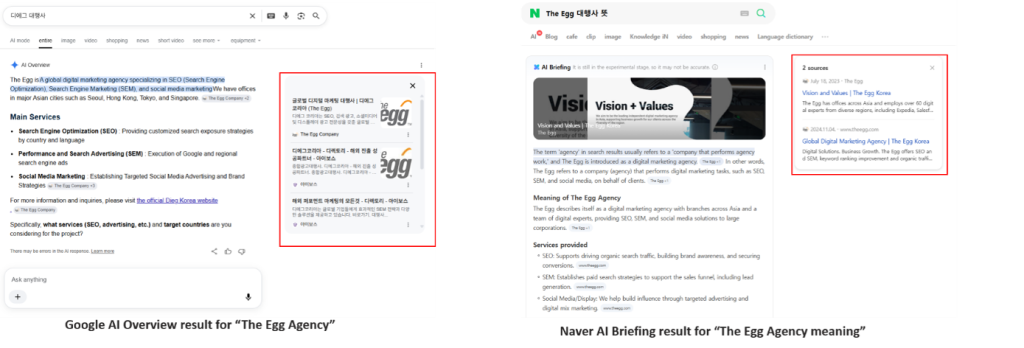
The Example of Google AI Overview and Naver AI Briefing
AI Answers Are Becoming a New Advertising Surface
AI-generated answers are no longer just an information layer. They are quickly becoming a new advertising surface.
- Google displays a labeled “Sponsored” product placement at the bottom of its AI Overview.
- Naver’s AI Briefing takes a more integrated approach: ads are placed directly inside the conversational text, marked with an “AD” tag, with product links woven into the answer itself rather than appended at the end.
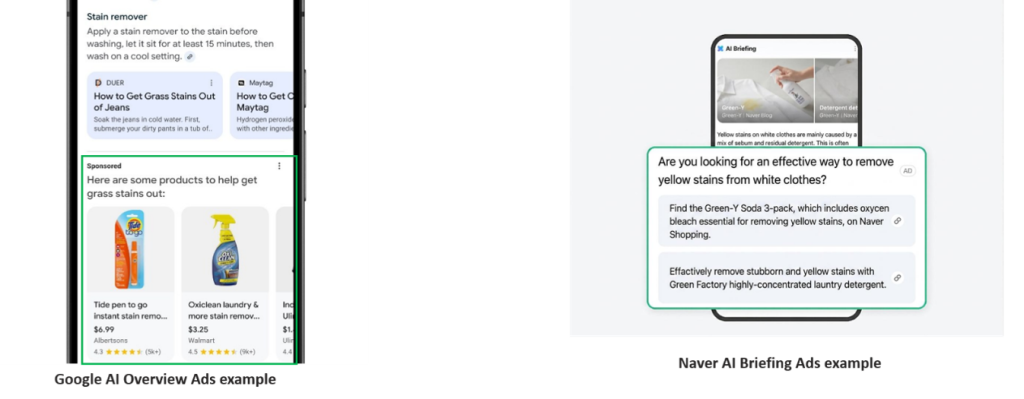
The Ads Example of Google AI Overview and Naver AI Briefing
Head-to-Head: Google AI Overview vs. Naver AI Briefing
| Google AI Overview | Naver AI Briefing | |
| Launch stage | Earlier rollout, more mature (2024) | Later launch, still expanding (2025) |
| Keyword coverage | Triggers across a wider range of queries (reportedly ~48% of searches) | Narrower, actively expanding |
| Ad format | “Sponsored” label at bottom of answer | “AD” tag embedded within the answer text |
Naver is currently behind Google in terms of launch timing and keyword coverage. Google has a head start, with AI Overviews reportedly appearing in around 48% of search queries, while Naver is targeting 40% coverage by the end of 2026. Naver launched later and is still expanding the range of queries that trigger AI Briefing responses.
Google AI Mode vs. Naver AI Tab: An Ecosystem Play
Moving beyond the single-answer format, both companies have launched dedicated conversational search experiences:
- Google AI Mode is built to pull products from multiple retailers across the open web, powered by a shopping feature that lets users compare and shop across brands and platforms in one conversational flow.
- Naver AI Tab takes the opposite approach: it’s heavily focused on keeping users inside Naver’s own ecosystem. It’s a conversational search tool built specifically to drive purchases through Naver Shopping. Notably, the tabs within Naver’s AI Tab include Blog, Cafe, Clip, and other native Naver content formats — and all shoppable products are sourced from Naver Store.
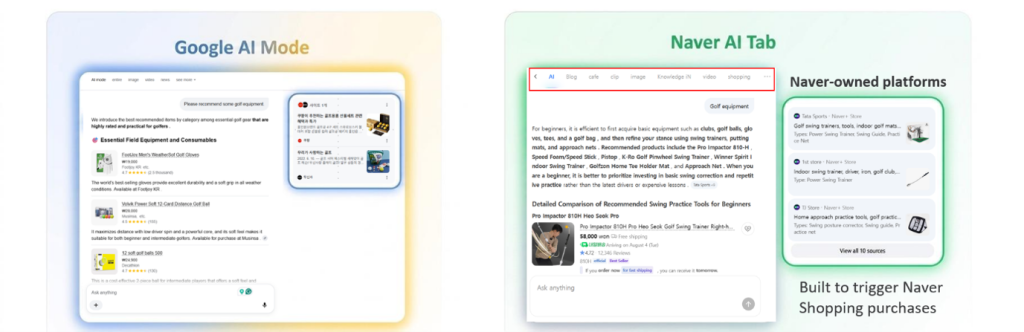
The Example of Google AI Mode and Naver AI Tab
Google is designed to provide users with greater access to information across the open web, while Naver places greater emphasis on keeping users within its own ecosystem and driving engagement and conversion. For brands, this means a Naver strategy cannot rely on SEO alone. It also needs to account for a presence across Naver Blog, Naver Cafe, and Naver Shopping as part of a broader, integrated search strategy.
Naver’s AI Briefing: Recent Updates and Shifting User Behavior
As AI Briefing provides users with direct answers rather than a traditional list of links, search behavior on Naver is changing in two ways:
- Longer, more conversational queries. Users are moving away from short keyword fragments and increasingly typing full, natural-language questions that more closely resemble how they would ask a person.
- More follow-up questions and deeper engagement. After receiving an initial AI-generated answer, users are continuing the interaction by asking clarifying or related questions rather than starting a new search from scratch.
This shift has direct implications for SEO. Content built primarily around keyword matching is becoming less effective, while content structured to answer complete questions and anticipate the logical follow-up questions that may come next is better positioned to perform in AI-driven search.
Naver AI Briefing Ads: Official Launch Timeline
Naver officially launched AI Briefing Ads in July 2026, introducing paid placements directly within AI-generated search responses. According to Naver’s advertiser announcement, the full rollout includes the following:
- Advertiser Center: Opened on July 15, 2026
- Ad exposure: Began on July 21, 2026
- Placement: Integrated Search and AI Briefing, limited to standalone AI Briefing summaries. AI Briefing content generated from user reviews within Smart Place listings is excluded.
- Billing: CPC-based, with pricing benchmarked against the average CPC of relevant Power Link ads. Advertisers cannot set bids manually.
- Targeting: Advertisers can directly control time-of-day and day-of-week targeting. Region, gender, age, and audience segments are used as signals by Naver’s ad agent rather than as fixed targeting criteria.
- Ad copy: Generated entirely by Naver’s ad agent using information from the Advertiser Center and landing page. Advertisers cannot manually edit the ad copy.
Naver’s Official Optimization Guidelines for AI Briefing Ads
Naver has also published AI Briefing Ads guidance outlining how advertisers can improve their chances of being selected for AI Briefing placements. The recommendations point to a different optimization approach from traditional search advertising:
- Strengthen your website’s schema markup. Naver’s ad agent uses schema markup, including @type, name, description, price, and aggregate rating, to understand the content and relevance of a landing page. More complete structured data can help the system better match the page with relevant AI Briefing queries.
- Use a clear, recognizable brand or site name. Because the ad appears within an AI-generated response, a distinctive site name helps users identify the advertiser and distinguish the commercial content from the surrounding answer.
- Install conversion tracking. Since Naver’s ad agent generates and optimizes the ad copy automatically, advertisers have less direct control over the creative. Conversion tracking therefore becomes more important for measuring what happens after the click and evaluating the effectiveness of AI-generated ads.
- Understand that Naver AI fully controls ad placement based on contextual relevance. AI Briefing Ads do not offer the same level of manual control as traditional search ads. Advertisers cannot select individual keywords, bids, creatives, or placements. Instead, Naver AI determines when and where an ad is shown based on the context and relevance of the AI Briefing response.
- Check category restrictions. Certain regulated categories are restricted from AI Briefing placements. This includes medical and healthcare advertising, where ad creatives are subject to additional review.
What this means for advertisers: AI Briefing Ads require a different approach from traditional search advertising. Rather than focusing primarily on keyword and bid optimization, advertisers need to strengthen the underlying data that Naver AI uses to understand and evaluate their landing pages. Structured data, clear brand information, and conversion tracking are therefore becoming increasingly important.
Content Strategy: From Volume to Value
AI tools can now generate generic content and images almost instantly. As a result, the volume of content online continues to grow, making it increasingly difficult for brands to stand out and demonstrate genuine value.
Naver has responded to this shift by placing greater emphasis on content quality and originality. Through its Search Advisor webmaster guidance and official blog, Naver has published clear recommendations for content creation, emphasizing that simply generated or repackaged content is unlikely to provide the quality and value that its search ecosystem prioritizes.
According to Naver’s official guidance, high-ranking content needs to demonstrate:
- First-hand experience: Content should reflect real experience and practical knowledge rather than simply repackaging information available elsewhere.
- Depth and topical focus: Sites that consistently build expertise around a specific subject area can establish greater authority within that topic.
- Authenticity: Content should be original, avoid copied or stitched-together material, and clearly identify external sources when they are used.
- Readable structure: Clear headings, short paragraphs, lists, and well-organized formatting make content easier for users to understand and navigate.
- Up-to-date information: Content should reflect current prices, policies, regulations, and other information that may change over time.
Naver does not position AI as something that should be avoided altogether. Instead, its guidance presents AI as a tool within the content creation process, with human expertise and perspective remaining essential. The recommendation is clear: rather than relying on AI for simple generation or summarization, content creators should add their own experience and perspective to produce genuinely original content.
Why Korea Requires Specialized Expertise
Unlike Google, Naver controls 60%+ of Korean search and prioritizes its own ecosystem (Naver Blog, Café, Shopping, Place). AI Briefing deepens this walled garden—success requires understanding Naver’s unique ranking signals, user behavior patterns, and content formats that don’t exist in Western markets.
We consistently see global agencies applying “international SEO best practices” to Korea and underperforming against Korea-native strategies. The platforms are fundamentally different, and winning AI search citation adds another layer of complexity that requires market-specific expertise.
The 5-Part Content Checklist Naver Wants You to FolloW
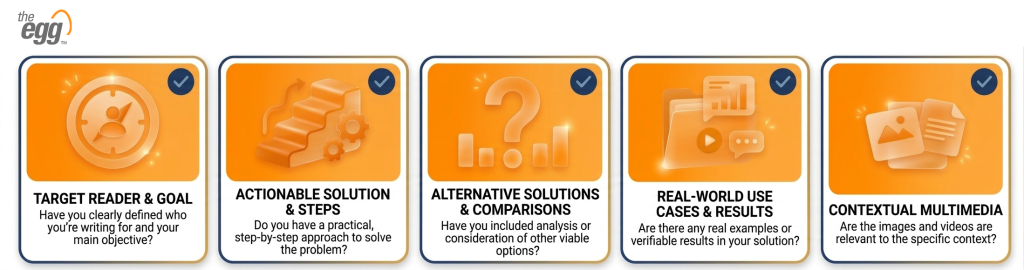
Naver Official 5 Content Checklist (translated into English)
To make its guidelines more actionable, Naver officially published a 5-part content checklist to help creators and brands self-assess whether their content meets the new standard. Here’s the checklist, along with what “good” looks like in practice versus what falls short:
1. Start with a Clear Audience and Use Case
Clearly identify who is reading, when, in what situation, and why — then write directly to that context.
Instead of creating a broad piece such as “Top 10 Restaurants,” consider the specific situation behind the search. For example, an office worker looking for a restaurant where they can finish lunch within 30 minutes needs practical information such as location, waiting time, price, and menu options.
The more closely content reflects the reader’s actual situation, the more useful it becomes.
2. Document the Experience, Not Just the Outcome
First-hand experience is difficult to replicate with generic content. Where possible, show how something was done, including the steps taken, problems encountered, and adjustments made along the way.
For example, a fitness article becomes more useful when it documents progress over several weeks, including changes in performance, setbacks, and what was changed to improve the results.
Specific details and real-world challenges give readers information they are less likely to find in generic summaries.
3. Help Readers Make a Decision
Content does not always need to recommend a single “best” option. In many cases, the most useful approach is to explain the alternatives and the circumstances in which each one makes sense.
Rather than simply describing a product as having a “reasonable price” or “great performance,” compare the options using relevant criteria and explain why one may be more suitable for a particular user or situation.
This turns content from a generic recommendation into a useful decision-making resource.
4. Share Specific, Measurable Results
Specific results make content more credible. When possible, explain how something was tested, over what period, and under what conditions.
For example, a product review could describe how it performed after three months of use, including measurable results such as noise levels, performance, or other relevant observations.
Simply reproducing information from a manufacturer’s specification sheet does not provide the same value as sharing what happened in actual use.
5. Use “Contextual Media” — Images and Charts That Actually Support Your Text
Images, videos, charts, and tables should help readers understand or evaluate the information being presented.
First-hand photos, comparison tables, process images, and measured results can reinforce the information in the text and make it easier to understand.
By contrast, unrelated stock imagery may add visual interest but little informational value. Content should make every visual element work harder to support the reader’s understanding.
What Naver’s AI Search Shift Means for Marketers
The underlying principle is simple: content needs to offer something beyond what AI can generate from existing information.
AI can support research, drafting, and content production, but the strongest content combines those capabilities with first-hand experience, original insights, specific results, and a clear point of view. Naver’s latest approach to AI search reflects this shift, placing greater emphasis on useful, credible content while also introducing new opportunities for brands through AI Briefing Ads.
For marketers in Korea, this means Naver can no longer be treated as just another SEO channel. Brands need to think across organic search, AI visibility, content quality, and paid placements as part of a broader Naver ecosystem strategy. The goal is not to avoid AI, but to use it as part of the workflow while ensuring the final content contains genuine expertise and information that cannot be easily reproduced by simply prompting a model.
The brands that adapt early will be better positioned to earn visibility as Naver’s AI search experience continues to evolve.