
2025–2026 Korean Search Trends: The Structural Shift Toward AI-Influenced Discovery
South Korea’s search ecosystem is undergoing one of its most notable shifts in over a decade. What was once a portal-dominated market led by domestic platforms is rapidly evolving into a multi-platform AI-influenced environment.
According to the AI Search Trend Report 2026 published by OpenSurvey, search behavior in Korea is no longer defined by familiarity or speed. Instead, users increasingly prioritize:
- Information quality
- Productivity enhancement
- AI-native interaction
This is not simply platform substitution. It is a structural shift in search intent, search workflow, and search retention.
AI Search Surges as Traditional Portals Decline
| Platform | March 2025 | December 2025 | Change (%p) |
| Naver | 85.3% | 81.6% | -3.7 |
| YouTube | 78.5% | 72.3% | -6.2 |
| 63.5% | 61.3% | -2.2 | |
| ChatGPT | 39.6% | 54.5% | +14.9 |
| Gemini | 9.5% | 28.9% | +19.4 |
Base: Users who used any search service in the last 3 months
Source: 2026 AI Search Trend Report, OpenSurvey
For years Naver, YouTube, and Google held an important role in the Korean search market, but that market landscape is now gradually diversifying. Two major changes stand out in this data. ChatGPT has solidified its position by crossing the 50% usage threshold. Simultaneously, Gemini has recorded the fastest growth in the industry, proving that users are increasingly migrating toward more sophisticated AI ecosystems.
This is not simply platform substitution. It is a structural shift in search intent, search workflow, and search retention.
AI Search Surges as Traditional Portals Decline
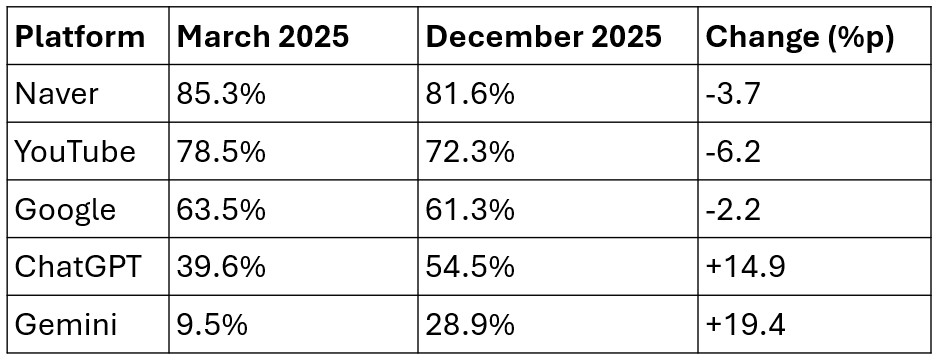
Base: Users who used any search service in the last 3 months
Source: 2026 AI Search Trend Report, OpenSurvey
For years Naver, YouTube, and Google held an important role in the Korean search market, but that market landscape is now gradually diversifying. Two major changes stand out in this data. ChatGPT has solidified its position by crossing the 50% usage threshold. Simultaneously, Gemini has recorded the fastest growth in the industry, proving that users are increasingly migrating toward more sophisticated AI ecosystems.
The shift toward AI-influenced discovery in Korea represents a significant change in how users search and find information.
We can help you understand what this means for your visibility strategy and how to adapt to these new patterns.
The shift toward AI-influenced discovery in Korea represents a significant change in how users search and find information. We can help you understand what this means for your visibility strategy and how to adapt to these new patterns.
Primary Search Preferences Shift Toward New Platforms
Primary Search Channel
| Rank | March 2025 | December 2025 |
| 1 | Naver (49.1%) | Naver (46.0%) |
| 2 | YouTube (15.0%) | Google (17.2%) |
| 3 | Google (11.6%) | YouTube (11.4%) |
| 4 | Instagram (5.2%) | ChatGPT (7.2%) |
Source: 2026 AI Search Trend Report, OpenSurvey
Key Observations:
- Naver remained the leading platform but declined from 49.1% to 46.0% (-3.1%p), indicating gradual diversification in user behavior.
- Google rose significantly to 17.2%, overtaking YouTube to become the second most selected primary search channel.
- YouTube experienced a decline from 15.0% to 11.4%, suggesting reduced reliance as a starting point for search.
- ChatGPT entered the top four for the first time at 7.2%, surpassing Instagram and signaling rapid adoption of AI-based search behavior.
These shifts suggest that AI platforms are moving beyond their role as secondary tools following traditional search engines. Instead, they are increasingly being used as initial touchpoints for information discovery, indicating a gradual shift in search behavior and digital visibility strategies in Korea.
Primary Search Preferences Shift Toward New Platforms
Primary Search Channel
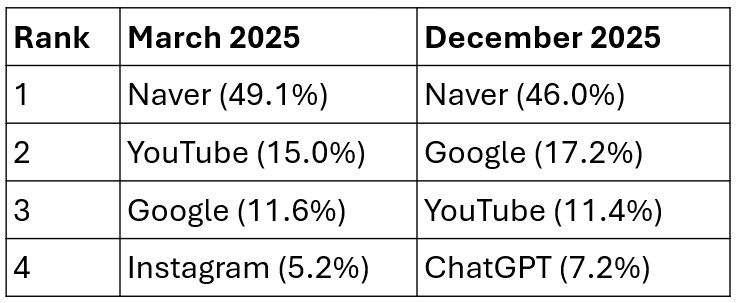
Source: 2026 AI Search Trend Report, OpenSurvey
Key Observations:
- Naver remained the leading platform but declined from 49.1% to 46.0% (-3.1%p), indicating gradual diversification in user behavior.
- Google rose significantly to 17.2%, overtaking YouTube to become the second most selected primary search channel.
- YouTube experienced a decline from 15.0% to 11.4%, suggesting reduced reliance as a starting point for search.
- ChatGPT entered the top four for the first time at 7.2%, surpassing Instagram and signaling rapid adoption of AI-based search behavior.
These shifts suggest that AI platforms are moving beyond their role as secondary tools following traditional search engines. Instead, they are increasingly being used as initial touchpoints for information discovery, indicating a gradual shift in search behavior and digital visibility strategies in Korea.
Search Intent Shifts Toward Productivity
Beyond platform ranking changes, intent patterns also show a noticeable shift.
Top Search Purposes (Multi-response, %)
| Purpose | March 2025 | December 2025 | Change |
| Place-related information | 46.1% | 40.6% | -5.5 |
| Knowledge acquisition | 45.5% | 47.6% | +2.1 |
| Shopping information | 42.4% | 39.4% | -3.0 |
| Work/Academic information | 31.5% | 37.4% | +5.9 |
Source: 2026 AI Search Trend Report, OpenSurvey
What stands out is not just the shift in rankings, but the nature of the growth.
Search behavior appears to be gradually shifting away from transactional or location-based queries toward more cognitively demanding tasks. Users are increasingly turning to search platforms to understand concepts, support professional tasks, and assist with structured research.
In other words, the dominant model is evolving:
- Previous pattern: Search to find places, products, or quick answers.
- Emerging pattern: Search to learn, organize information, and support productivity.
This evolution naturally aligns with platforms designed to assist with synthesis, summarization, and structured output generation, which may partially explain the growing adoption of AI-based tools in primary search behavior.
Search Intent Shifts Toward Productivity
Beyond platform ranking changes, intent patterns also show a noticeable shift.
Top Search Purposes (Multi-response, %)
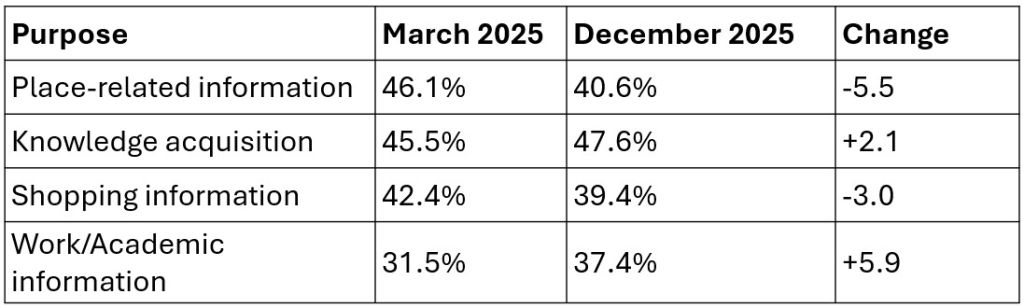
Source: 2026 AI Search Trend Report, OpenSurvey
What stands out is not just the shift in rankings, but the nature of the growth.
Search behavior appears to be gradually shifting away from transactional or location-based queries toward more cognitively demanding tasks. Users are increasingly turning to search platforms to understand concepts, support professional tasks, and assist with structured research.
In other words, the dominant model is evolving:
- Previous pattern: Search to find places, products, or quick answers.
- Emerging pattern: Search to learn, organize information, and support productivity.
This evolution naturally aligns with platforms designed to assist with synthesis, summarization, and structured output generation, which may partially explain the growing adoption of AI-based tools in primary search behavior.
User Satisfaction and Competitive Dynamics: ChatGPT vs. Gemini
Overall Satisfaction
| Service | March 2025 | December 2025 |
| ChatGPT | 73.1% | 75.6% |
| Gemini | 58.5% | 72.6% |
Source: 2026 AI Search Trend Report, OpenSurvey
User satisfaction data between March and December 2025 shows meaningful movement particularly for Gemini. The most notable shift is the scale of improvement on Gemini’s side. A gain of 14.6 percentage points within the year suggests that user perception is evolving quickly rather than stabilizing around a single dominant player.
ChatGPT continues to be rated highly in terms of perceived relevance, indicating strong alignment with user expectations. However, trust perception shows a slight softening. In contrast, Gemini’s improvement appears to be driven not only by functionality but also by broader experience and credibility factors.
Taken together, the data points toward competitive convergence. Instead of a winner-takes-all scenario, the AI search landscape is moving toward a more balanced environment where multiple platforms are strengthening their positions simultaneously.
User Satisfaction and Competitive Dynamics: ChatGPT vs. Gemini
Overall Satisfaction
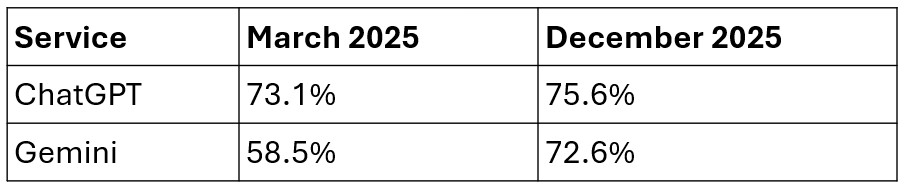
Source: 2026 AI Search Trend Report, OpenSurvey
User satisfaction data between March and December 2025 shows meaningful movement particularly for Gemini. The most notable shift is the scale of improvement on Gemini’s side. A gain of 14.6 percentage points within the year suggests that user perception is evolving quickly rather than stabilizing around a single dominant player.
ChatGPT continues to be rated highly in terms of perceived relevance, indicating strong alignment with user expectations. However, trust perception shows a slight softening. In contrast, Gemini’s improvement appears to be driven not only by functionality but also by broader experience and credibility factors.
Taken together, the data points toward competitive convergence. Instead of a winner-takes-all scenario, the AI search landscape is moving toward a more balanced environment where multiple platforms are strengthening their positions simultaneously.
The way these AI-influenced search trends affect visibility can vary widely depending on the industry.
We can help you look at what this means for your sector and where the main opportunities may be.
The way these AI-influenced search trends affect visibility can vary widely depending on the industry. We can help you look at what this means for your sector and where the main opportunities may be.
What This Means for SEO in 2026
The Korean search environment is becoming more diversified and AI-influenced. Traditional portals remain important, but they are no longer the only entry point for discovery. Search behavior is increasingly shaped by intent depth and AI-assisted interaction.
Based on the recent shifts, several strategic directions stand out.
Strategic Implications:
Content Must Be Structured for Both Humans and AI
As AI-driven platforms become part of the discovery journey, content clarity matters more than ever.
This means:
- Logical structure and hierarchy
- Clear summaries and direct answers
- Strong topical consistency
- Demonstrated expertise
Content that is easy to parse and interpret is more likely to surface across both traditional search engines and AI-assisted interfaces.
Depth Is Becoming More Valuable Than Volume
With growth in knowledge acquisition and work-related search intent, surface-level traffic content may lose relative impact.
More analytical, research-oriented, and insight-driven content is better aligned with evolving user behavior. Instead of focusing purely on high-volume keywords, SEO strategies may need to prioritize depth, authority, and contextual relevance.
Multi-Platform Visibility Is Mandatory
Search discovery is no longer confined to a single ecosystem.
Users increasingly navigate across platforms such as Naver, Google, ChatGPT, Gemini, and YouTube, in addition to various social channels.
As a result, optimization strategies must consider how content is indexed, interpreted, and potentially retrieved by large language models, not just how it ranks in traditional SERPs.
Brand Authority Matters More Than Ever
As AI systems summarize and synthesize information, the likelihood of citation or reference depends heavily on perceived credibility.
Clear sourcing, strong brand positioning, and consistent topical authority may therefore play a larger role in visibility. In an AI-integrated search environment, trust signals are not just branding elements. They directly influence discoverability.
Overall, SEO in 2026 is less about dominating a single platform and more about building structured, authoritative content that performs across interconnected search ecosystems.