

MOST POPULAR SEARCH ENGINES IN CHINA – 2026
Despite the rising importance of social search in China, traditional search engines still play a crucial role in influencing local purchasing behaviors. Among nearly 1.1 billion (1,123 million) internet users in China, 69.8% use search engines to find and purchase products and services, driving the highest consumer market in the world. However, search engines in China are unlike those anywhere else in the world.
With Google not being present, Baidu has emerged as the leading local search engine, continually competing with the international giant Bing for user loyalty and market share.
In this article, we will introduce the most popular search engines in China and how to connect with the country’s vast audience.
What is the most popular search engine in China?
Baidu is the most popular search engine in China, holding a market share of 63.97% as of November 2025. It is often referred to as “China’s Google.” Baidu offers various features, including search, maps, news, and translation. It also has some unique capabilities, such as the ability to search for information using Chinese dialects.
Bing is the #2 most popular search engine in China, with a market share of 15.97% across all devices.
Since Baidu launched AI Overview at the beginning of 2025, its market share has been steadily increasing over the past 12 months. Its market share increased by nearly 20 percentage points, rising from 45.15% in December 2024. In contrast, Bing’s market share dropped by over 20 percentage points, falling from 37.74% last year to 15.97%.
TOP SEARCH ENGINES IN CHINA BY MARKET SHARE
CHINA’S SEARCH ENGINE MARKET SHARE (ALL DEVICES)
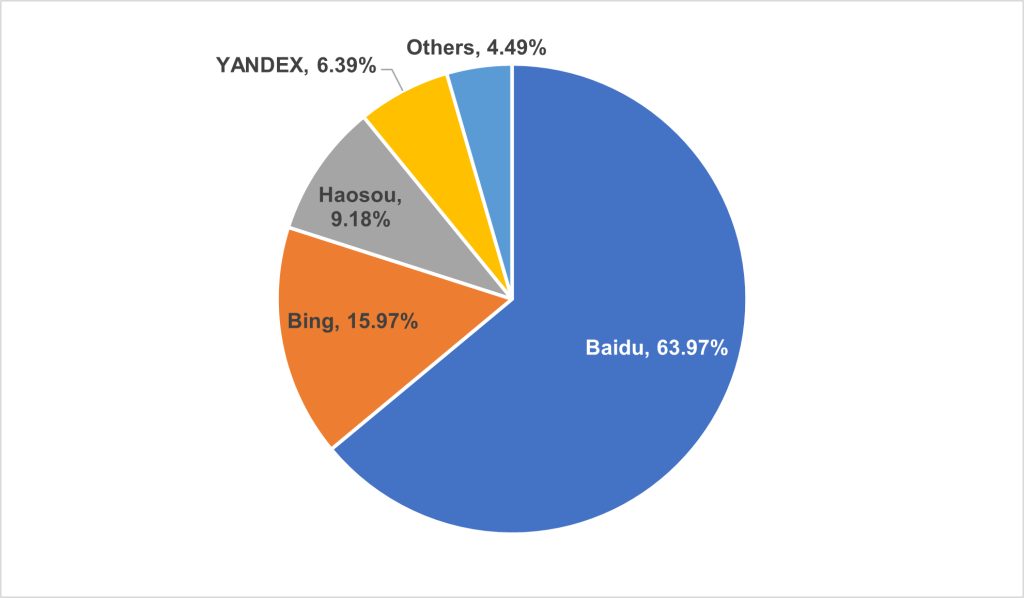
- Baidu 63.97%
- Bing 15.97%
- Haosou 9.18%
- Others 4.49% (YANDEX, Sogou, Google etc.)
Source: StatCounter (as of Nov 2025)
Despite Baidu’s overall market dominance, the breakdown by desktop and mobile tells a different story.
CHINA’S SEARCH ENGINE MARKET SHARE (DESKTOP)
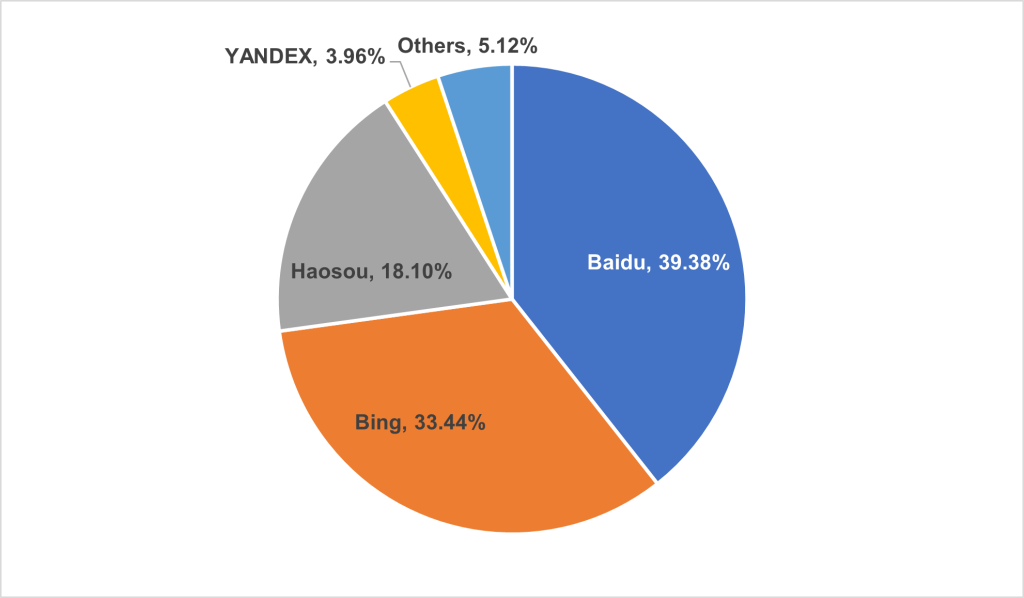
- Baidu 39.38%
- Bing 33.44%
- Haosou 18.1%
- Others 9.08% (Google, Sougou, YANDEX etc.)
Source: StatCounter (as of Nov 2025)
- Baidu holds a market share of 39.38% among desktop users in China. After adding AI search capabilities in January 2025, Baidu’s market share has steadily increased. Following the addition of AI features, searches now produce improved Knowledge Cards, engaging AI-generated Stories, and richer search results.
- Interestingly, Bing’s desktop market share is 33.44%.
CHINA’S SEARCH ENGINE MARKET SHARE (MOBILE)
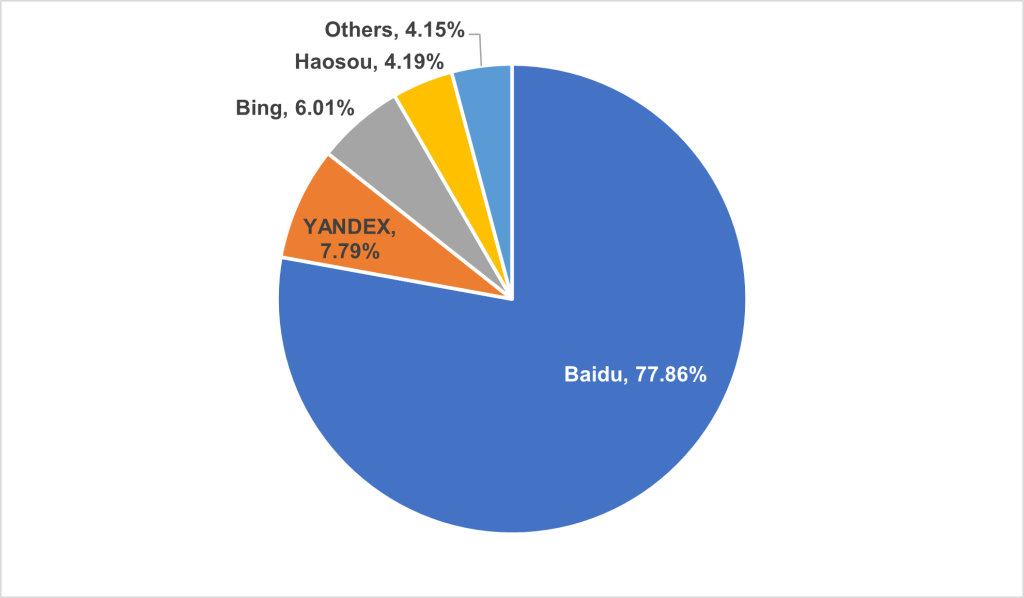
- Baidu 77.86%
- YANDEX 7.79%
- Bing 6.01%
- Haosou 4.19%
- Others 4.15% (Shenma, Sougou etc.)
Source: StatCounter (as of Nov 2025)
Observing the mobile sector:
- Baidu dominates the mobile search market with a share of 77.86%.
- Up until November 2025, Bing was ranked second in mobile market share. It then fell to third place (behind Yandex), experiencing a dramatic drop in its share from 18.84% in November 2024 to 6.01%.
Baidu leads on mobile, while Bing remains strong on desktop, making device-specific optimization important in China.
Therefore, across all devices, Baidu and Bing are the two most popular search engines in China, providing brands with unparalleled opportunities to reach the thriving internet population in China, which is eager for content and technology.
For international brands looking to enter the Chinese market, investing in Bing is certainly worthwhile, but it is also essential to consider Baidu, the search engine that local users are more familiar with.
To help you tap into this substantial market potential, let’s explore the latest trends, market shares, and similarities and differences between Baidu and Bing.
AI IN ACTION
China’s search landscape is rapidly evolving with AI, especially with Bing’s AI-generated Stories and Knowledge Cards. At The Egg, we leverage our expertise in AI integration to optimize content and technical SEO for both Baidu and Bing. This ensures our clients achieve enhanced visibility and sustained success in China’s dynamic market.
BAIDU VS BING: INTRODUCTION TO THE MOST POPULAR SEARCH ENGINES IN CHINA
What makes China’s search market unique?
China has developed its own platforms that understand unique Chinese language, culture, and search intent. Localizing content for Chinese platforms is critical to connecting with Chinese users—knowing and actioning upon how and why they search will get you found.
Despite the impact of Bing, a global search engine, the local giant Baidu remains strong. The platform provides users with valuable information through various channels, including websites, news, images, videos, and blogs.
Baidu even has its own properties, such as Baidu Baike (the Chinese answer to Wikipedia), Baidu Baijiahao (Baidu’s online publishing platform for self-media), Baidu Images for visual search, and more.
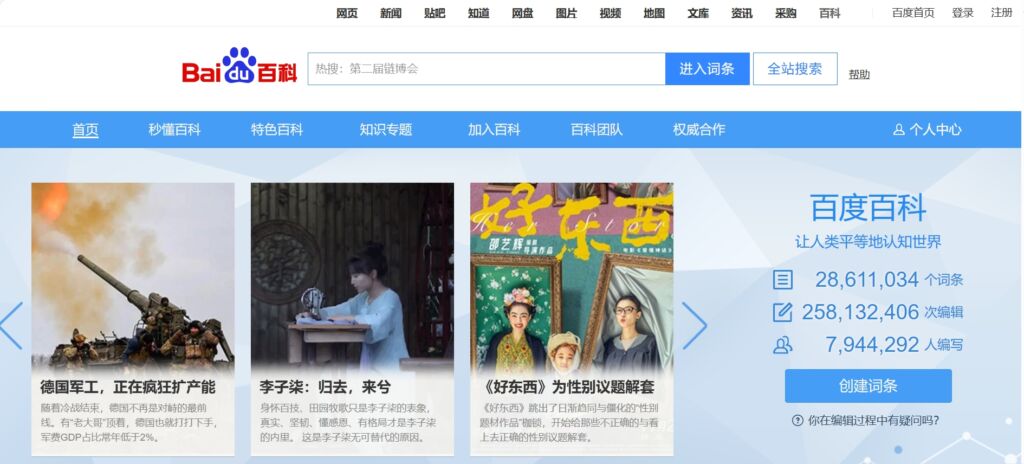
Baidu Baike interface
In comparison, Bing is more responsive to changes in website content and can deliver a more diverse and valuable range of web results to users, which is a key reason for its rising market share. Additionally, Bing also provides high-quality content from Baidu, such as Baidu Baike, which is well-received by users.
However, Bing’s search ecosystem is undergoing continuous adjustments. Observing trends over the past 12 months, the proportion of advertisement results on the Bing CN homepage search results is on the rise, which has had a negative impact on user experience.
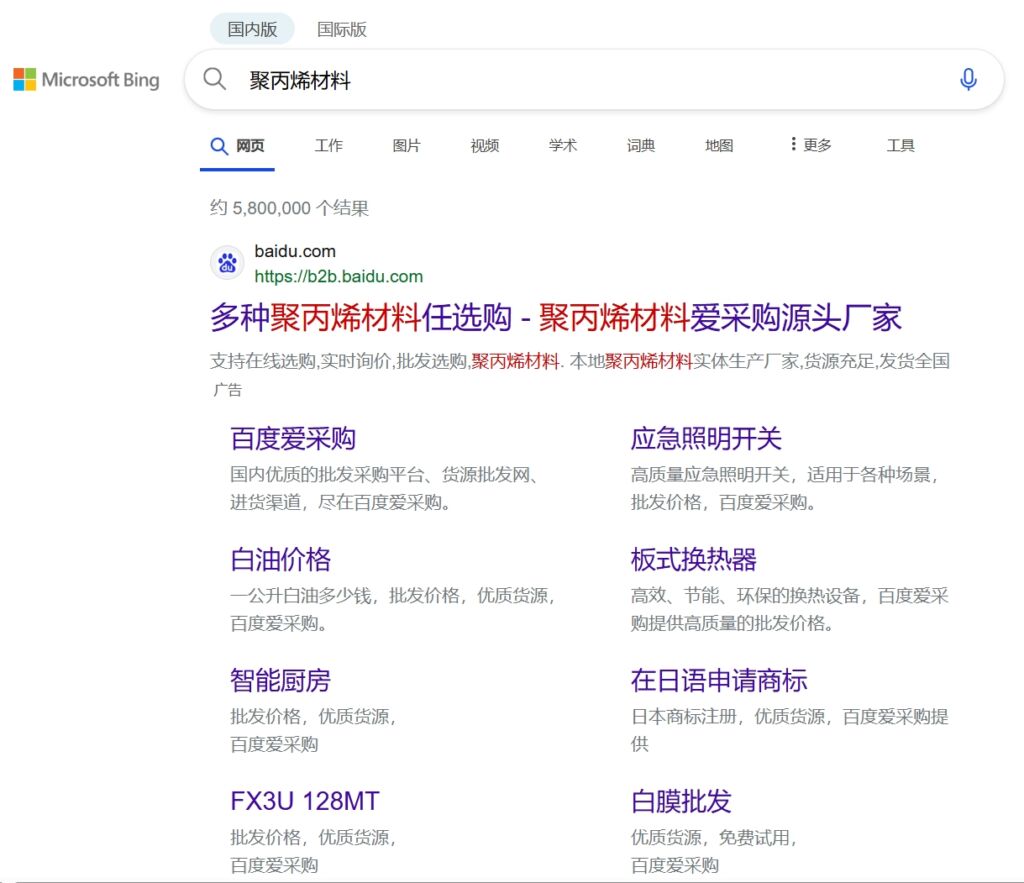
Advertisement results on Bing
TOP SEARCH ENGINES IN CHINA: RECENT TRENDS & PAST DATA
SEARCH ENGINE MARKET SHARE IN CHINA
Since 2021, Baidu’s market share on desktop has been on a continuous downtrend, dropping sharply from 57.96% to 35.93% in 2022 alone.
This downward trend is partly due to Bing challenging Baidu’s dominant position in the search engine market. During this period, Bing underwent multiple version updates, focusing on visual upgrades, feature enhancements, and improvements in user experience, making it more attractive to users.
As concerns about the Baidu search experience have emerged, Bing’s market share has significantly increased from 18.02% in 2021 to 50.41% in 2024. In March 2024, Bing announced the addition of AI Q&A features to its search results in Bing China, which may also be a factor contributing to its rising popularity.
However, Baidu gradually introduced AI-powered search services in 2024, and particularly after launching AI overview and AI chat in February 2025 in collaboration with DeepSeek technology, it began to reclaim the market share it had previously lost.
SEARCH ENGINE |
2019 |
2020 |
2021 |
2022 |
2023 |
2024 |
2025 |
|---|---|---|---|---|---|---|---|
| Baidu | 42.46% | 24.88% | 52.32% | 35.93% | 38.30% | 30.64% | 39.38% |
| Microsoft Bing | 5.92% | 5.29% | 18.02% | 24.80% | 33.93% | 50.41% | 33.44% |
| Haosou | 4.51% | 3.56% | 5.42% | 7.34% | 14.66% | 13.14% | 18.1% |
| Sogou | 40.45% | 59.96% | 12.64% | 27.20% | 6.36% | 1.59% | – |
| 6.41% | 6.08% | 10.78% | 3.81% | 4.52% | 3.03% | 3.15% |
China’s search engine market share (desktop): From 2019 to 2025 (as of November 2025)
SEARCH ENGINE |
2019 |
2020 |
2021 |
2022 |
2023 |
2024 |
2025 |
|---|---|---|---|---|---|---|---|
| Baidu | 81.19% | 92.82% | 94.71% | 79.45% | 79.13% | 67.99% | 77.86% |
| Microsoft Bing | 0.64% | 0.35% | 0.64% | 2.64% | 3.98% | 18.60% | 6.01% |
| Shenma | 10.87% | 2.79% | 1.74% | 6.46% | 3.72% | 2.77% | – |
| Sogou | 6.32% | 2.69% | 1.17% | 2.08% | 4.48% | 2.16% | 1.9% |
| Haosou | 0.42% | 0.82% | 0.37% | 3.22% | 2.76% | 2.21% | 4.19% |
China’s search engine market share (mobile): From 2019 to 2025 (as of November 2025)
TOP SEARCH ENGINES IN CHINA: BAIDU VS Bing
BAIDU VS BING: SERP RANKINGS
Baidu tends to display results that are more self-referential on its SERP, while Bing’s search results are more diverse.
For example, when searching for “旅游景点” (tourist attractions) on Baidu and Bing, Baidu Maps appears at the top of Baidu’s SERP, while the first organic search result on Bing is ctrip.com.
At the same time, Baidu’s Baijiahao content occupies multiple positions on its SERP. For instance, the last four search results on the first SERP for the query “tourist attractions” are all from Baijiahao.
Since Bing also recognizes that Baidu Baike provides high-quality content, the entries from Baidu Baike can occupy prominent positions in Bing’s search results for certain keywords.
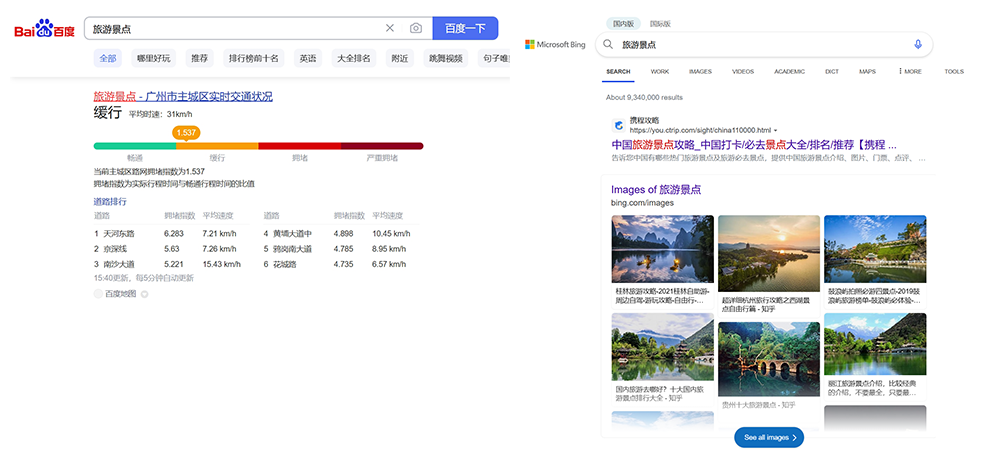
Baidu’s SERP (left) vs. Bing’s SERP (right): “旅游景点” (travel attractions)
BAIDU VS BING: SERP STRUCTURE
To maximize page load speed and improve user experience, both Baidu and Bing display up to 10 organic results per page by default.
The screenshot below highlights how the SERPs for both search engines are structured:
- Organic search results, which are similar across both SERPs, are outlined in red
- Paid search ads are outlined in green
- Vertical search results (based on topic, media type, and content genre) are outlined in blue
- Results from Baidu- and Bing-owned properties like Baidu Baike, Bing Maps etc., are outlined in purple
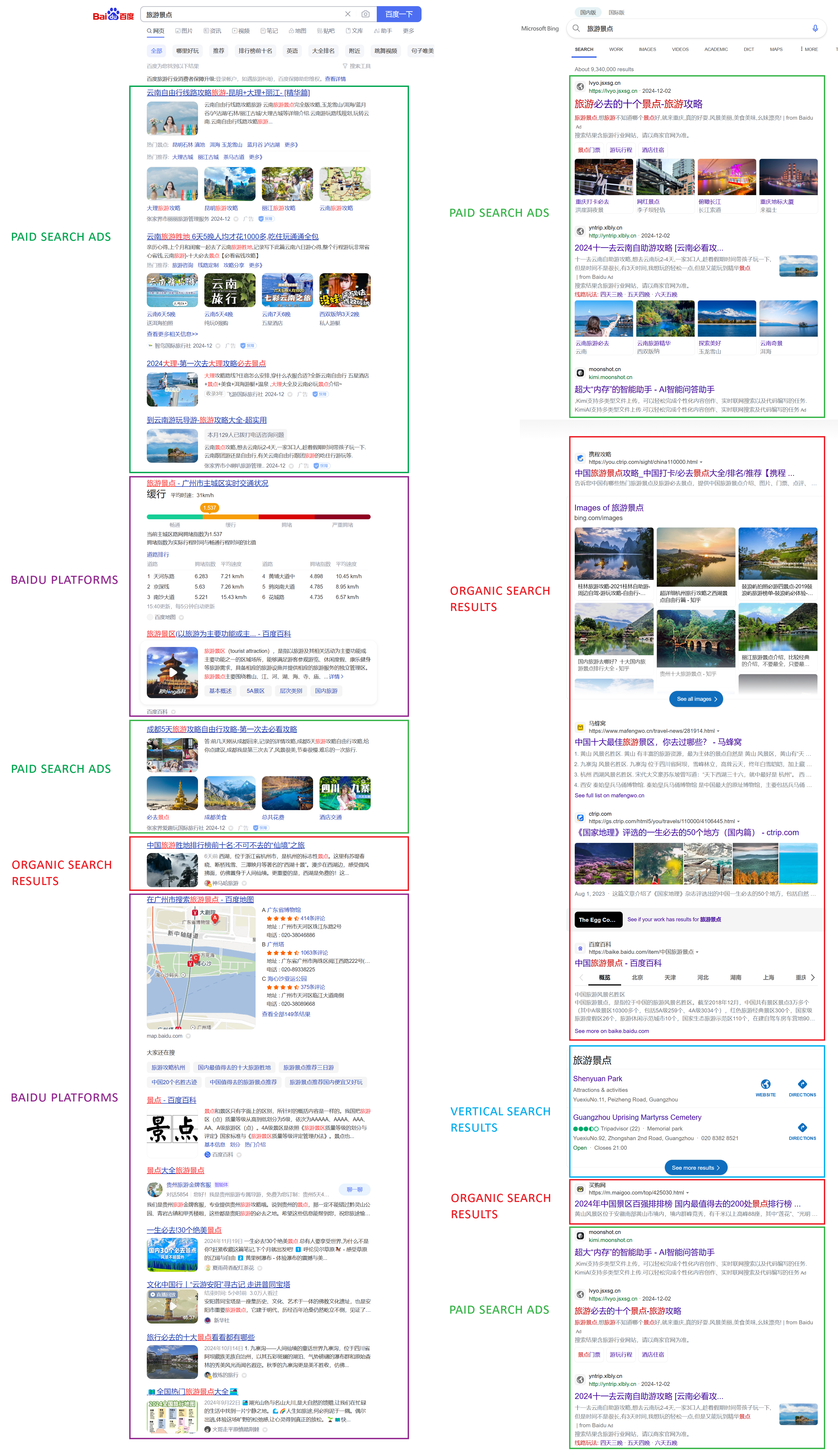 Baidu’s SERP (left) vs. Bing’s SERP (right): “旅游景点” (travels attractions)
Note: Baidu lets users change the default settings to display up to 50 results on the SERP. But this customizability is currently not available on Bing.
BAIDU VS BING: SERP SNIPPETS
On both SERPs, organic results generally feature a title, followed by a simple snippet with information about that page’s content, then the landing page URL or the name of its website/Baidu Baijiahao (or publisher number).
In some cases, there is a feature image to the left of the meta description.
Baidu and Bing have similar organic listings on their SERPs. On both, the search term (the example below shows “Swarovski” as the search term) is in red to highlight the relevance of the page’s content to the search query.
Search results from officially verified websites on Baidu display an “official” (“官方”) icon in blue after the title tag. Websites that have not been verified by the relevant search engine will not have this icon. Bing does not have such certification, but websites can achieve rich media results by adding Schema Markup code, making their official sites more prominent.
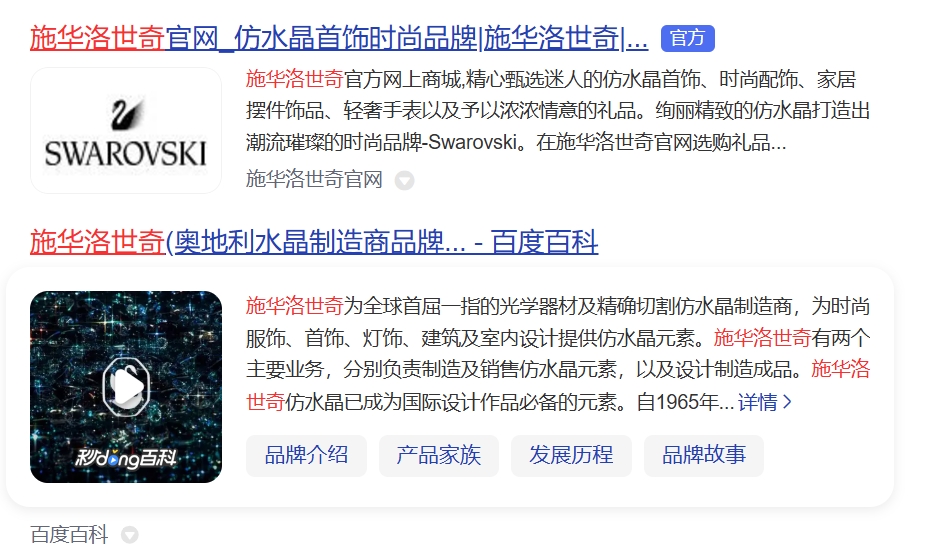 Organic search results on Baidu’s SERP
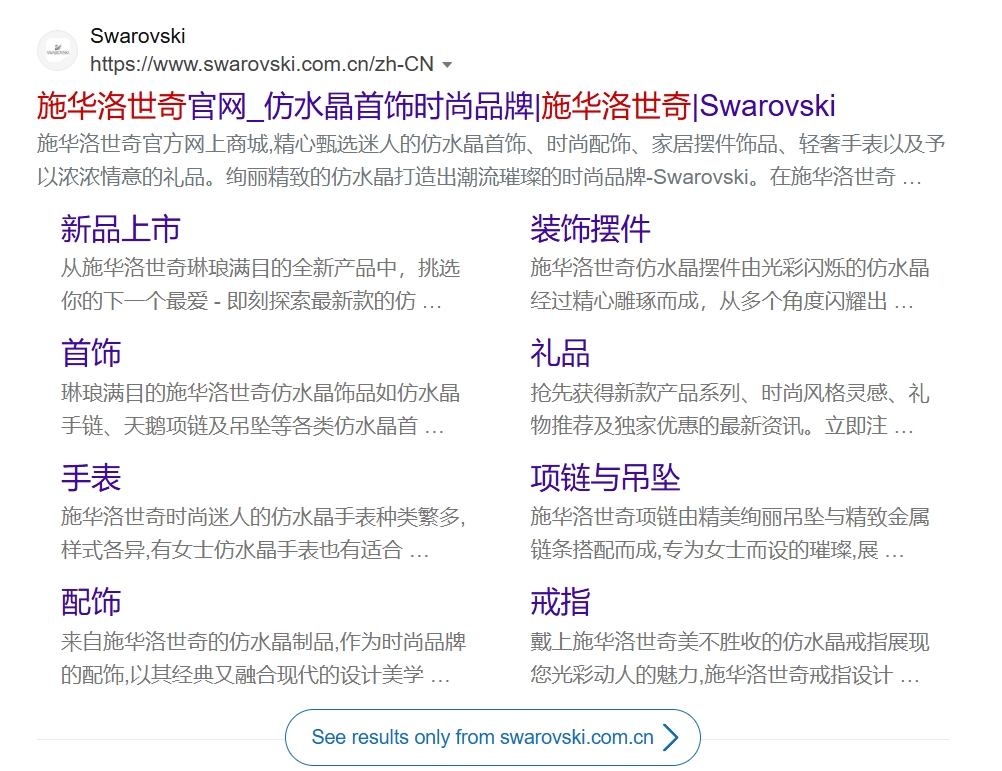 Organic search results on Bing’s SERP
BAIDU VS bing: PAID SEARCH DISPLAY
Both Baidu and Bing display advertisement results on their SERPs, with ads appearing at the top, bottom, and possibly interspersed within the organic search results.
Advertisement results must have an ad label, but Bing’s ads are relatively harder for users to notice. On certain search result pages with a large number of ads, Bing may have fewer than 10 organic search results, whereas Baidu typically has at least 9 organic search results.
Learn more about paid search in China.
Which search engine is most popular in China?
Baidu is the largest search engine in China, with a market share of 63.97%. Bing is the second-ranked search engine in China, holding a market share of 15.97%.
However, as Baidu and Bing continue to integrate organic search results and paid search results in their SERPs, users who prefer a simpler search experience may find themselves toggling between these two search engines while looking forward to a new search engine that offers straightforward search results.
Ultimately, to succeed in China, it is essential to localize for Chinese users, understand how Baidu and Bing interpret SEO best practices, and incorporate that understanding into an overall SEO strategy.